

For people who suffer from chronic migraine, everyday life can feel like a constant battle. Headaches that come 15 or more days a month, with at least eight of them being full-blown migraines, don’t just hurt-they steal sleep, work, and time with family. If you’ve tried pills like topiramate, propranolol, or even antidepressants and still get slammed by pain, you might have heard about Botox as an option. But is it just another cosmetic trick turned medical? Or does it actually help? The answer isn’t simple, but for the right person, it can change everything.
What Is Botox Doing in a Migraine Clinic?
Botox, or onabotulinumtoxinA, isn’t just for smoothing forehead lines. It’s a purified protein made from the bacterium Clostridium botulinum. For decades, doctors used it to treat muscle spasms in conditions like cerebral palsy and eye twitching. Then, in the early 2000s, patients getting Botox for wrinkles started saying their headaches got better. That wasn’t coincidence. Researchers ran big clinical trials-called PREEMPT-and found something real: Botox could cut down migraine days for people with chronic migraine.
The FDA approved it for this use in 2010. Since then, over 1.2 million people in the U.S. alone have used it as a preventive treatment. But here’s the catch: it doesn’t work for everyone. It’s not meant for occasional migraines. If you get headaches fewer than 15 days a month, Botox won’t help. It’s built for the people stuck in the cycle of daily pain.
How Does It Actually Stop Migraines?
Most people think Botox works by relaxing muscles. That’s part of it, but it’s not the whole story. Migraines aren’t just about tight neck muscles. They’re about nerves firing the wrong signals, flooding the brain with pain chemicals.
What Botox does is block the release of key pain messengers-especially CGRP (calcitonin gene-related peptide). This protein spikes during a migraine attack and keeps the pain going. By stopping CGRP from being released at nerve endings around the head and neck, Botox reduces the inflammation and nerve sensitivity that drive chronic migraine.
It also interferes with SNAP-25, a protein nerves need to send pain signals. Think of it like cutting a wire in a faulty alarm system. The alarm doesn’t go off because the signal can’t get through. This happens not just in the muscles, but in the sensory nerves themselves. Studies from the Barrow Neurological Institute show Botox doesn’t just numb the area-it changes how the nervous system responds to pain over time.
This is why it’s called a preventive, not a rescue. You don’t take it when a headache hits. You get it regularly so the system doesn’t get wired to scream pain all the time.
Who Gets the Most Out of Botox?
If you’re wondering whether Botox is right for you, here’s who sees the best results:
- You have chronic migraine: 15 or more headache days a month, with at least 8 being migraines.
- You’ve tried at least three other preventive medications and they didn’t work-or you couldn’t tolerate the side effects.
- You have medication-overuse headache: using painkillers more than 10 days a month, which makes migraines worse.
- You also deal with tension-type headaches or neck pain that doesn’t go away.
- You’re over 18 (or 12+, since the FDA expanded approval in 2023 for teens).
People who get 20+ headache days a month often see the biggest drop in numbers-like going from 25 days down to 10. But even those with 15-18 days get meaningful relief. One patient on Reddit said after three rounds, their worst migraines went from debilitating to manageable.
On the flip side, if you get migraines only 4-6 days a month, Botox won’t help. Clinical trials proved it doesn’t work for episodic migraine. It’s not a one-size-fits-all fix.
What Does the Treatment Actually Look Like?
Getting Botox for migraine isn’t like a quick spa appointment. It’s a medical procedure with a strict protocol called PREEMPT.
You’ll get between 31 and 39 tiny injections across seven specific areas:
- Forehead (frontalis)
- Between the eyebrows (corrugator and procerus)
- Sides of the head (temporalis)
- Back of the head (occipitalis)
- Neck (cervical muscles)
- Shoulders (trapezius)
The total dose is usually 155 to 195 units. Each session takes about 15 minutes. No anesthesia is needed-just a tiny needle. Most people feel a quick pinch. About 18% report mild soreness afterward, and 7% get temporary weakness in the forehead or neck muscles.
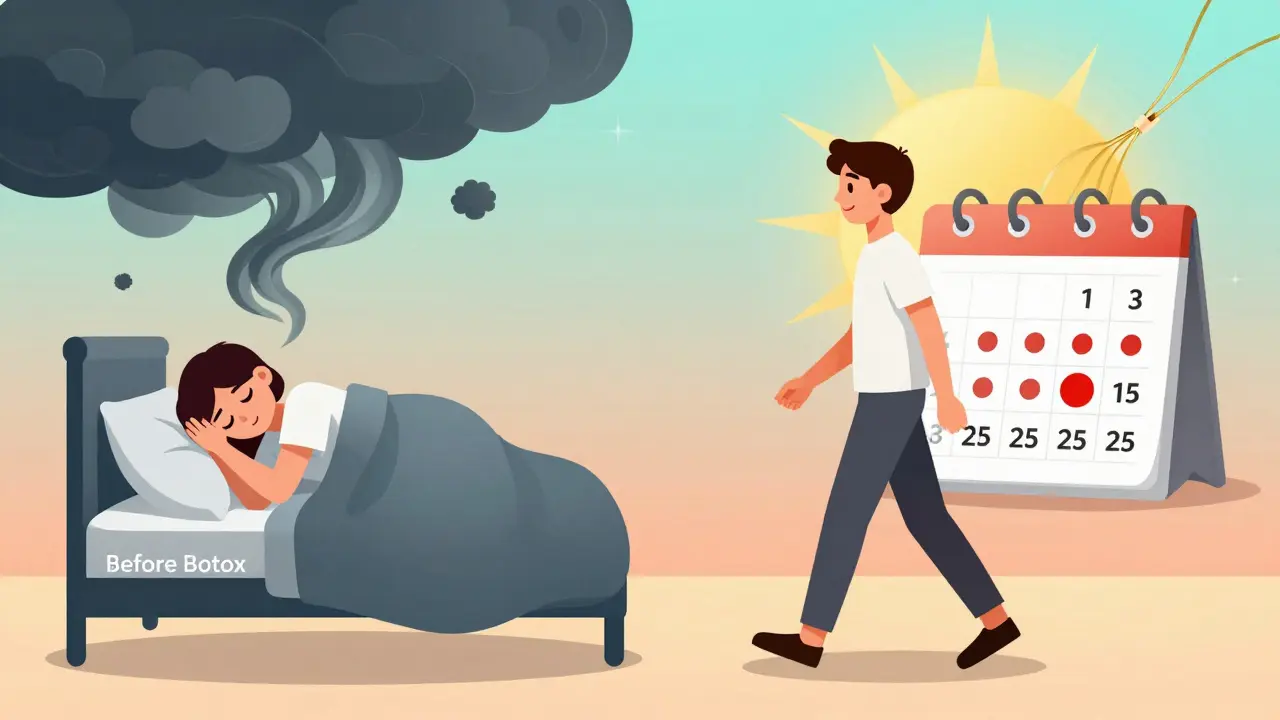
You’ll need to come back every 12 weeks. Most people don’t feel the full effect until their third or fourth treatment. A 2021 study found 61% of patients only saw major improvement after hitting that fourth cycle.
Only doctors trained in the PREEMPT method should give these injections. That means neurologists or headache specialists who’ve completed certification through the American Headache Society. A bad injection job can reduce effectiveness by up to 30%.
How Effective Is It Really?
Let’s talk numbers. In the original PREEMPT trials, people on Botox had 8-9 fewer headache days a month compared to 6-7 for placebo. That’s a real difference.
Real-world data from 1,247 patients in 2022 showed even better results: 63.2% had at least a 50% drop in headache days. On average, they lost 12.3 days a month. That’s like gaining over a week of pain-free time every month.
Compared to other preventives:
- Topiramate: 38.5% of patients had 50% reduction
- Propranolol: 35.1%
- Erenumab (CGRP antibody): 51.8%
- Botox: 47.2%
It’s not the most effective single treatment, but it’s close. And here’s the big advantage: side effects.
Topiramate causes brain fog, tingling, weight loss, and kidney stones in up to 35% of people-so many quit. Botox’s most common side effects are neck pain (9.7%), headache (6.9%), and drooping eyelid (3.2%). Most people tolerate it just fine.
One patient on Migraine.com said: “I stopped taking topiramate because I couldn’t think straight. Botox didn’t make me feel like a zombie. I finally slept through the night.”
Cost, Insurance, and Access
Let’s be honest-cost matters. One treatment cycle runs $1,500 to $1,800. That’s $6,000 to $7,200 a year. But most major insurers cover it if you meet the criteria.
To get approved, you usually need:
- Diagnosis of chronic migraine by a doctor
- Proof you tried at least three other preventives
- At least 3 months of headache diary records
Insurance companies often deny the first request. You’ll likely need to appeal. Many clinics have staff who handle this for you.
85% of insurers cover Botox for migraine when the paperwork is done right. But if you’re underinsured or uninsured, the cost can be a barrier. Some pharmaceutical assistance programs exist-ask your doctor.

What About Combining It With Other Treatments?
Here’s something exciting: Botox works even better when paired with newer migraine drugs.
CGRP monoclonal antibodies like erenumab or fremanezumab are taken monthly as shots or pills. They target the same pain pathway as Botox-but from a different angle. A 2023 study showed that when used together, 68.4% of patients hit the 50% reduction mark. That’s higher than either treatment alone.
Doctors are starting to use this combo for patients who still struggle after one treatment. It’s not standard yet, but it’s becoming more common in headache centers.
And research is moving forward. AbbVie (the maker of Botox) is testing a longer-lasting version that could last 16 to 20 weeks instead of 12. That would mean fewer visits and lower costs over time.
What Are the Downsides?
Botox isn’t perfect. Here’s what you should know:
- It takes time: Don’t expect miracles after the first shot. Wait for at least three cycles.
- It’s not for acute attacks: You still need triptans or gepants for when a migraine hits.
- It’s not permanent: If you stop treatments, your headaches will likely return.
- Temporary weakness: Some people report drooping eyelids or neck stiffness for a few weeks after injections.
- Insurance battles: Many patients spend months fighting for coverage.
One Reddit user wrote: “I got Botox and thought it was magic. Then my next cycle came and my headaches were back to normal. I didn’t realize it had to be consistent. Now I don’t miss a session.”
Consistency is key. Treat it like a maintenance plan-not a cure.
Is It Worth It?
If you’ve been stuck in the migraine grind-trying pills, dealing with side effects, missing work, canceling plans-Botox might be the reset you need.
It’s not a miracle. But it’s one of the few treatments specifically designed for chronic migraine, backed by solid science, and approved by experts worldwide. The European Headache Federation and the American Headache Society both list it as a first-line option.
It won’t help if you’re getting migraines once a week. But if you’re getting them once a day-or worse-it’s worth talking to a headache specialist.
Most patients who stick with it say the same thing: “I didn’t know life could feel this normal again.”
Can Botox stop a migraine when it starts?
No. Botox is a preventive treatment, not a rescue. It works over time to reduce how often migraines happen, but it doesn’t stop a migraine once it’s already underway. For acute attacks, you still need medications like triptans, gepants, or NSAIDs.
How long does it take for Botox to start working for migraines?
Most people don’t feel the full benefit until after their second or third treatment cycle, which is about 6 to 9 months. Some notice small improvements after the first round, but the biggest drops in headache days usually show up after the fourth session.
Is Botox safe for long-term use?
Yes. Botox has been used for chronic migraine for over 12 years with no serious safety concerns in post-marketing surveillance. The most common side effects are mild and temporary, like neck pain or eyelid drooping. Long-term studies show no loss of effectiveness or increased risk with repeated use.
Can teens get Botox for migraines?
Yes. In June 2023, the FDA expanded approval to include adolescents aged 12 to 17 with chronic migraine. A 2022 trial showed teens had an average reduction of 7.8 headache days per month compared to 4.2 with placebo. Treatment follows the same PREEMPT protocol as adults.
What happens if I stop getting Botox treatments?
Your migraine frequency will likely return to pre-treatment levels within a few months. Botox doesn’t cure migraine-it manages it. Stopping treatment removes the ongoing suppression of pain signals, so symptoms typically come back. Most patients who benefit choose to continue treatments indefinitely.
Can I use Botox with other migraine meds?
Yes. Many patients use Botox along with acute treatments like triptans or gepants. Some also combine it with CGRP monoclonal antibodies, which can improve results. But you should never combine it with other botulinum toxin products. Always tell your doctor what else you’re taking.
Do I need a referral to get Botox for migraines?
Usually, yes. Most insurance plans require a referral from your primary doctor to a neurologist or headache specialist. The specialist will confirm your diagnosis, review your treatment history, and determine if you meet criteria for coverage. Self-referral to cosmetic clinics won’t work-this is a medical treatment, not a beauty procedure.
Are there alternatives to Botox for chronic migraine?
Yes. Other first-line options include beta-blockers (like propranolol), anti-seizure drugs (like topiramate), and newer CGRP monoclonal antibodies (like erenumab or fremanezumab). Non-medical options include CBT, biofeedback, and neuromodulation devices. But Botox remains one of the few treatments proven effective specifically for chronic migraine with a low side effect profile.



Eric Gebeke on 18 January 2026, AT 22:02 PM
Let me be clear - this isn’t medicine, it’s corporate greed dressed up as science. Botox was never meant for this. The FDA approved it because drug companies paid off the right people. You think those 39 injections are random? Nah. They’re mapped to maximize billable units. And don’t get me started on the ‘PREEMPT protocol’ - that’s just a fancy word for ‘how to squeeze $1,800 out of your insurance every 12 weeks.’ I’ve seen patients go broke chasing this ‘miracle.’ It’s a scam wrapped in a lab coat.