
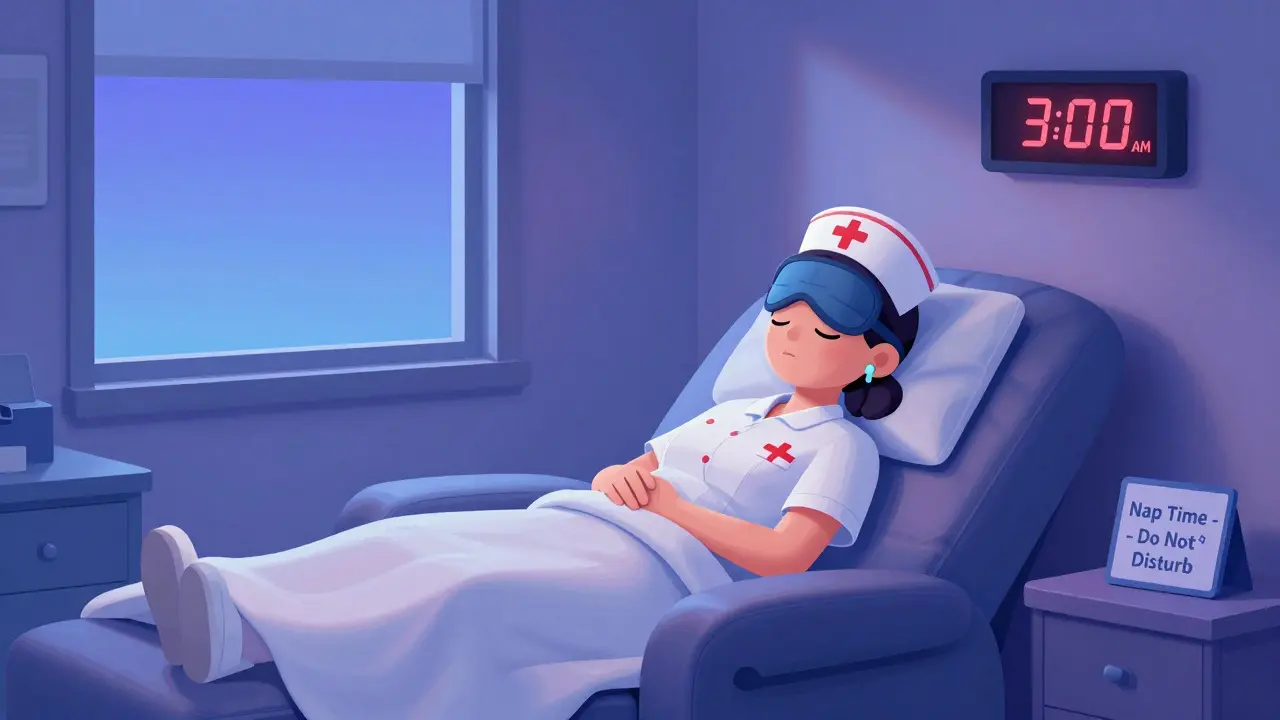
Shift work isn’t just inconvenient-it’s physically taxing. If you’re working nights, rotating shifts, or covering early mornings, your body is fighting a constant battle against its natural rhythm. You’re not just tired-you’re at higher risk for mistakes, accidents, and long-term health problems. But there’s a simple, science-backed tool that can help: strategic napping.
Why Napping Works for Shift Workers
Your body runs on a 24-hour clock. When you work overnight, you’re asking it to stay awake during its deepest sleep window-usually between 2 a.m. and 4 a.m. That’s when melatonin peaks and alertness drops. Without intervention, performance declines sharply. Studies show reaction times slow, attention wanders, and decision-making gets sloppy. In healthcare, this isn’t just about feeling groggy-it’s about medication errors, missed vital signs, and delayed responses. Strategic napping isn’t about catching up on sleep. It’s about interrupting that dip in alertness with a short, timed rest. Research from NASA in the 1990s found that a 26-minute nap improved pilot performance by 34% and alertness by 54%. Similar results show up in nurses, EMTs, and truck drivers. The key? Timing and length.The Science Behind the Perfect Nap
Not all naps are created equal. A nap longer than 30 minutes risks pulling you into deep sleep. When you wake up from deep sleep, you’re hit with sleep inertia-that foggy, disoriented feeling that can last 15 to 45 minutes. For a shift worker, that’s dangerous. The sweet spot? 20 to 30 minutes. This gives your body enough time to enter light sleep, which restores alertness, without slipping into deep sleep. Studies using the Karolinska Sleepiness Scale show that naps in this window improve alertness ratings by an average of 7.3 out of 10. Nurses who napped during their shifts reported feeling noticeably sharper during the final hours of their night shift. Physiologically, strategic nappers show measurable changes: 22% lower cortisol (the stress hormone), 18% faster reaction times, and 37% quicker sleep onset when napping in quiet, dark spaces. Even a 16-minute nap-common in real-world settings-can reduce drowsy driving incidents by 44% on the way home.When to Nap: Timing Matters More Than You Think
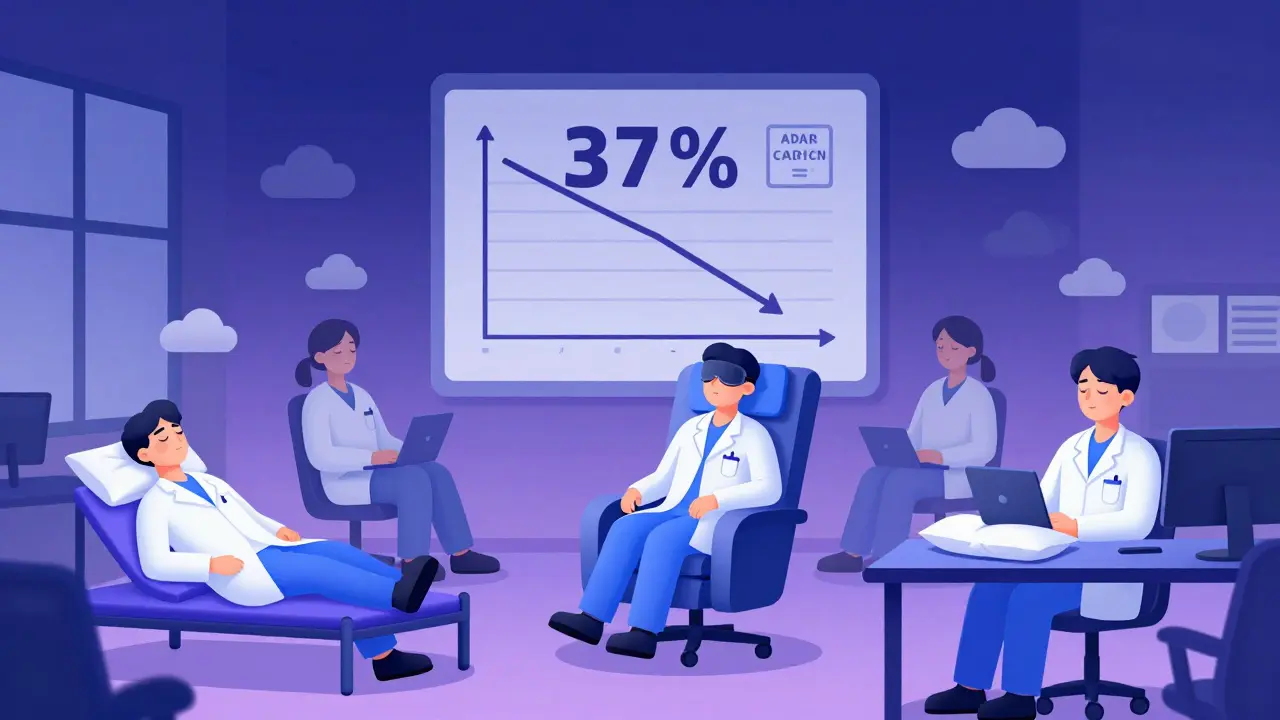
It’s not enough to just nap somewhere, anytime. The most effective naps happen during the body’s natural circadian low. For night-shift workers, that’s between 2 a.m. and 4 a.m. This aligns with the body’s peak melatonin release and lowest core temperature. Napping earlier (like at midnight) or later (after 5 a.m.) doesn’t give the same boost. A 2024 study in Frontiers in Sleep Medicine confirmed this: naps taken between 2 a.m. and 4 a.m. delivered the highest alertness gains, with 78% of workers reporting significant improvements. Napping at 1 a.m. helped-but not as much. Napping after 5 a.m.? Almost no benefit. This isn’t just theory. In hospitals that implemented scheduled naps at 3 a.m., nurses reported fewer medication errors and better communication with patients. One unit saw a 37% drop in errors over six months.
How Napping Beats Other Fatigue Fixes
You’ve probably heard about caffeine, bright lights, or “sleep banking” (getting extra sleep before a shift). These help-but not as well as a well-timed nap. Caffeine takes 20 to 30 minutes to kick in and wears off unevenly. A 200mg dose might help you stay awake, but it doesn’t restore cognitive function like sleep does. Light therapy can shift your circadian rhythm-but it takes days of consistent use. Sleep banking helps, but only by about 19% compared to strategic napping during the shift. A direct comparison from Caldwell et al. (2009) showed that strategic napping provided 32% greater improvement in sustained attention than caffeine alone during the last two hours of a 12-hour night shift. That’s the difference between catching a mistake and missing it.Why Most Places Still Don’t Do It
Despite the evidence, only 28% of U.S. hospitals have formal nap policies. Why? Two big reasons: staffing and stigma. Managers worry: “Who covers the floor while someone naps?” In many units, there’s no one to cover. A 2011 study found that 83% of nurse managers cited staffing shortages as the main barrier. Meanwhile, 67% of night-shift workers say they feel judged for napping-like they’re slacking off. That’s not just unfair-it’s dangerous. When people hide their need for rest, they nap in unsafe places: bathrooms, supply closets, or their cars. The solution? Structure. Successful programs don’t leave napping to chance. They build it into the schedule. Dedicated nap rooms-soundproofed, dimmable, temperature-controlled-boost compliance by 89%. Scheduled 20- to 30-minute breaks at 3 a.m. make it normal, not optional.How to Implement a Nap Program (Even If You’re Not a Manager)
You don’t need to be in charge to start making change. Here’s what works:- Start small. Talk to your team. Ask if others feel exhausted during the third hour of the shift. Chances are, they do.
- Propose a trial. Suggest a 2-week test: one quiet room, 20-minute naps at 3 a.m., no questions asked. Track how many people use it and whether errors or near-misses drop.
- Use data. Share the numbers. CDC studies show a $2.30 return for every $1 spent on nap programs-thanks to fewer accidents and lower turnover.
- Protect the space. If you can’t get a room, use a break room after hours. Cover windows. Use a sleep mask. Play white noise.
- Train yourself. Learn to fall asleep fast. Practice deep breathing. Avoid screens before napping. Set an alarm-no exceptions.
The Bigger Picture: It’s Not Just About Alertness
Strategic napping doesn’t just make you safer at work. It protects your long-term health. Shift workers have a 40% higher risk of heart disease, a 30% higher risk of breast cancer, and double the risk of duodenal ulcers. These aren’t random. They’re linked to chronic sleep disruption. Napping doesn’t fix the root cause-working nights still stresses your biology. But it reduces the damage. A 2025 study in BMC Nursing found that nurses who napped after four straight night shifts needed 63% fewer recovery days to get their sleep back on track. And it’s getting harder to ignore. California passed a law in 2022 requiring nap opportunities for night-shift healthcare workers. OSHA’s 2024 draft guidelines now list strategic napping as a “best practice.” The European Union mandates rest facilities for night workers. And by 2030, 78% of occupational health experts predict this will be standard in high-risk industries.What to Avoid
Don’t nap too long. Over 30 minutes = sleep inertia. Don’t nap after 5 a.m. It won’t help. Don’t nap in a bright, noisy room. Use earplugs and a mask. Don’t nap right after eating-wait 20 minutes. And don’t feel guilty. This isn’t laziness. It’s science.Final Thought: You Deserve to Be Alert
Working nights is hard. Your body wasn’t built for it. But you don’t have to suffer silently. A 20-minute nap isn’t a luxury-it’s a performance tool. Like hydration or proper footwear, it’s part of doing the job safely. If you’re a shift worker, try it. Set an alarm. Find a quiet spot. Close your eyes. Let your body reset. You’ll be sharper, safer, and maybe even a little less tired the next day.How long should a strategic nap be for shift workers?
The optimal nap length is 20 to 30 minutes. This allows the body to enter light sleep, which restores alertness without triggering deep sleep. Naps longer than 30 minutes increase the risk of sleep inertia-a groggy, disoriented state that can last up to 45 minutes after waking. Studies show that 20- to 30-minute naps improve reaction time by 18% and reduce sleepiness ratings by 7.3 out of 10 on the Karolinska Sleepiness Scale.
What time of night is best for a nap during a night shift?
The best time to nap is between 2:00 a.m. and 4:00 a.m. This window aligns with the body’s natural circadian low point, when melatonin levels peak and core body temperature drops. Napping during this period delivers the greatest boost in alertness and cognitive performance. Naps taken earlier (e.g., midnight) or later (after 5 a.m.) show significantly less benefit.
Can napping replace getting enough sleep before a shift?
No. Strategic napping is not a substitute for adequate pre-shift sleep. It’s a tool to manage fatigue during the shift. Workers who nap without first getting 7 to 8 hours of sleep before their shift still experience high fatigue. The most effective approach combines pre-shift sleep with one or two short naps during the shift. Research shows that combining both methods reduces end-of-shift fatigue by 40% more than either alone.
Do I need a special room to nap at work?
A dedicated nap room improves compliance and effectiveness-but it’s not required. A quiet, dimly lit break room with a reclining chair or cot works. Key factors are darkness (use blackout curtains or a sleep mask), quiet (earplugs or white noise), and temperature control (ideally 65-68°F). CDC studies found that units with dedicated nap rooms had 89% higher nap compliance than those using standard break rooms.
Is napping at work allowed in healthcare settings?
Yes-and it’s increasingly required. The Joint Commission, OSHA, and the American Nurses Association now support structured napping during night shifts. California’s 2022 Fatigue Risk Management Act mandates nap opportunities for healthcare workers on 12-hour shifts. Many hospitals have formal policies, especially in intensive care, emergency departments, and operating rooms. If your workplace doesn’t allow it, you can advocate for a trial program using data from CDC and NASA studies.



Noluthando Devour Mamabolo on 15 March 2026, AT 02:45 AM
20-30 mins is the sweet spot 🌙💤-no more, no less. I’ve tried longer and woke up feeling like I got hit by a bus. Now I set a 25-min alarm, wear a sleep mask, and use noise-canceling earbuds playing white noise. Game changer. Also, nap before the 3 a.m. slump, not after. Timing is everything.