
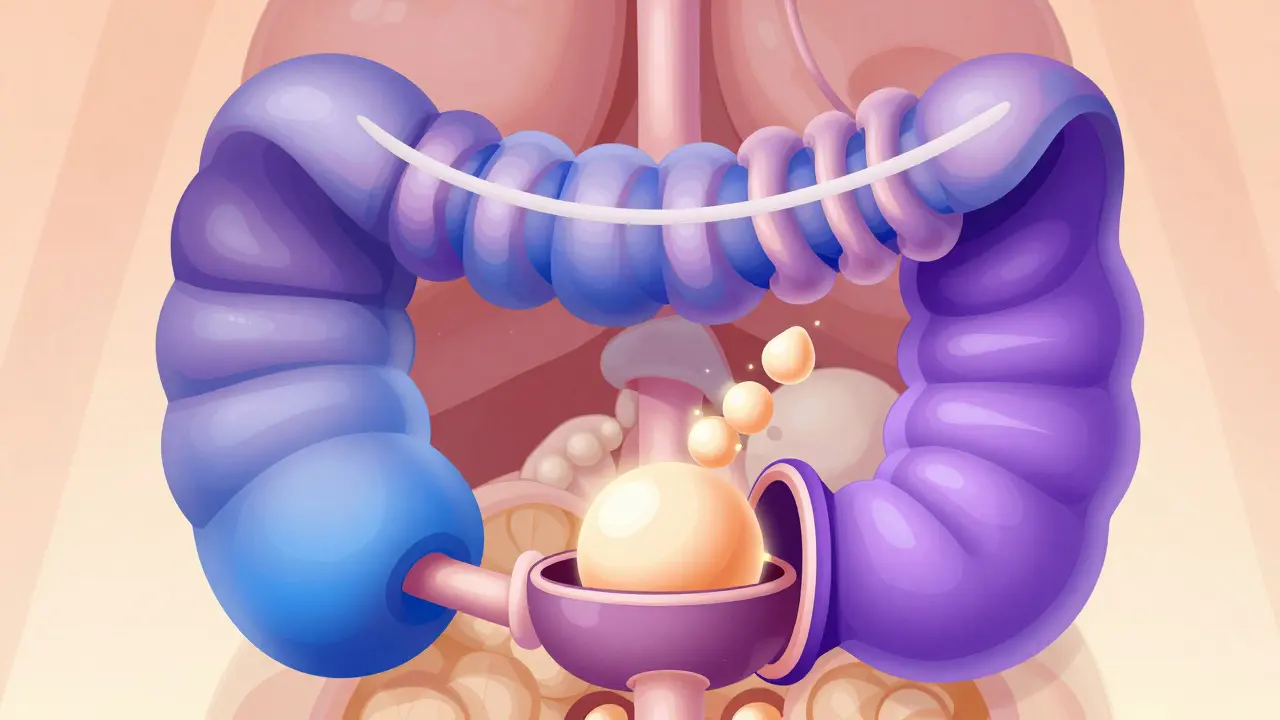
Swallowing seems simple-until it isn’t. If you’ve ever felt food sticking in your chest, or had to drink water just to get a bite down, you’re not alone. For many people, this isn’t just occasional trouble-it’s a sign of something deeper: an esophageal motility disorder. These aren’t just rare oddities. They’re real, underdiagnosed conditions that mess with the muscle contractions moving food from your throat to your stomach. And the key to fixing them? It starts with understanding what’s actually happening inside your esophagus.
What’s Really Going On in Your Esophagus?
Your esophagus isn’t just a tube. It’s a muscular pump. Every time you swallow, coordinated waves of contraction-called peristalsis-push food down. At the bottom, the lower esophageal sphincter (LES) opens just enough to let food into the stomach, then snaps shut to keep it from coming back up. When this system breaks down, things go wrong. Food lingers. Liquids leak. Chest pain mimics a heart attack. And the body’s natural signal-dysphagia, or difficulty swallowing-becomes your only warning.
Not all dysphagia is the same. Some people struggle only with solids at first, then liquids. Others feel food stuck for hours. A 2023 survey from Boston Medical Center found that 92% of achalasia patients reported this slow progression. And it’s not just swallowing. About 78% end up regurgitating undigested food. Weight loss? Common. Average loss? 15 to 20 pounds. Many patients spend years being told they have acid reflux, popping proton pump inhibitors (PPIs) daily-only to find out later that their problem isn’t acid at all. It’s muscle.
Why Manometry Is the Gold Standard
Endoscopy can rule out tumors or strictures. Barium swallows show where food gets stuck. But neither tells you why. That’s where high-resolution manometry (HRM) comes in. Think of it as a pressure map of your esophagus. A thin tube with 36 tiny sensors, spaced 1 centimeter apart, is passed through your nose. As you swallow water, it records pressure changes along every inch of the esophagus. The result? A color-coded topography map-like a weather map, but for muscle contractions.
This isn’t new. Dr. Friedenwald and Dr. Palmer first measured esophageal pressure in 1946. But the real breakthrough came in the early 2000s with HRM. Before that, doctors relied on older systems with just 4 to 6 sensors. Now, with 36 sensors, we can see patterns that were invisible before. The Chicago Classification v4.0, published in 2023, turned this into a universal language. It’s now the standard used worldwide to diagnose these disorders.
HRM isn’t perfect. It’s invasive. About 35% of patients report discomfort during the test. And it’s not available everywhere. A system costs $50,000 to $75,000. Only 35% of community hospitals in the U.S. have one. But its accuracy? Unmatched. For diagnosing achalasia, HRM hits 96% sensitivity. Barium swallow? Just 78%. That’s why the American College of Gastroenterology recommends endoscopy first, then HRM if no blockage is found.
The Major Disorders and How They Show Up
Not all motility disorders are the same. The Chicago Classification v4.0 groups them into clear types:
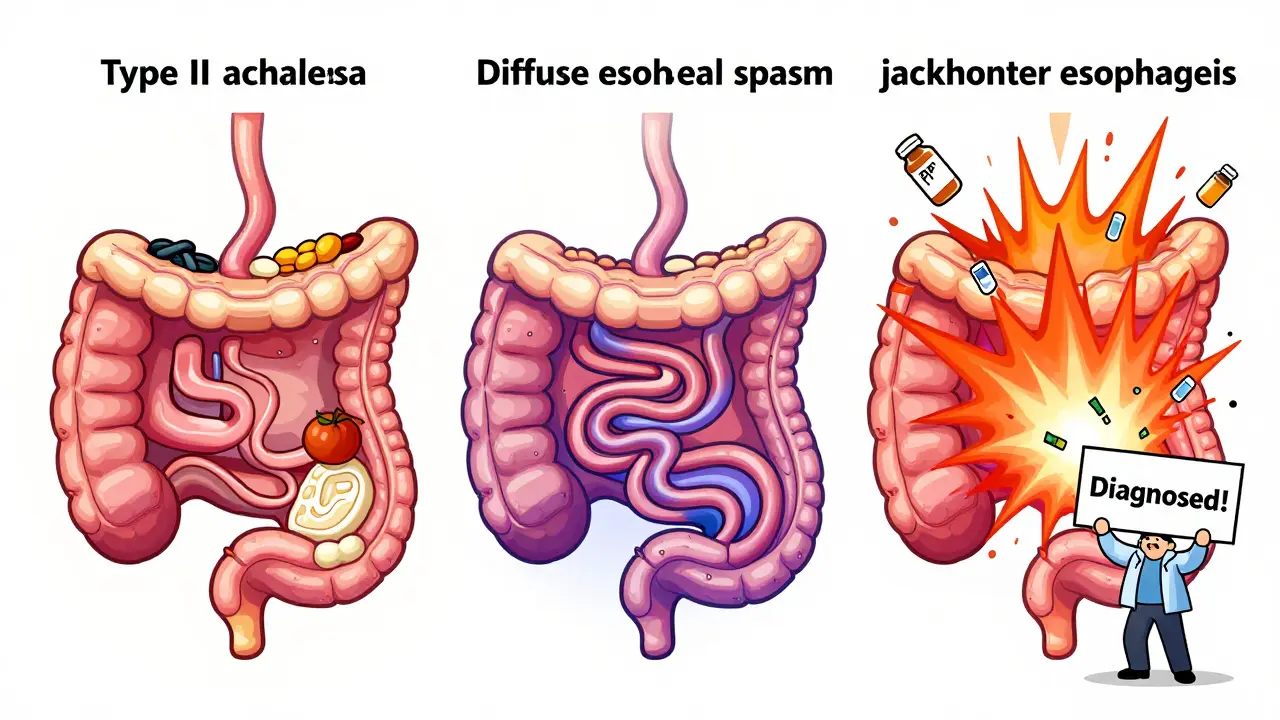
- Achalasia: The most common primary disorder. The LES won’t relax, and the esophagus stops contracting. It’s split into three types: Type I (no contractions), Type II (pan-esophageal pressurization-70% of cases), and Type III (spastic contractions). Symptoms? Progressive dysphagia, regurgitation, chest pain. Often misdiagnosed as GERD.
- Diffuse Esophageal Spasm (DES): Chaotic, uncoordinated contractions. Can cause severe chest pain that feels like a heart attack. Patients often end up in the ER multiple times before getting the right diagnosis.
- Nutcracker Esophagus: Contractions are strong but coordinated. Pressure exceeds 180 mmHg. Often linked to chest pain without dysphagia.
- Jackhammer Esophagus: Extreme contractions. Distal contractile integral exceeds 5,000 mmHg•s•cm. One patient described it: “I was on PPIs for eight years before manometry showed this.”
- Hypertensive LES: Resting pressure over 26 mmHg. The sphincter stays too tight, even when it shouldn’t.
Secondary disorders matter too. About 80% of people with scleroderma develop esophageal motility problems. Fibrosis slowly replaces muscle tissue, turning the esophagus into a floppy, non-working tube. These cases need different management-often focused on the underlying autoimmune disease.

What the Test Reveals: More Than Just Numbers
HRM doesn’t just measure pressure. It tests function. The Multiple Rapid Swallows (MRS) test is a hidden gem. You swallow five quick sips in a row. In a healthy person, the esophagus shuts down briefly-no contractions-and the LES relaxes. In disorders like achalasia, this inhibition doesn’t happen. The esophagus keeps spasming. This single test helps distinguish between true achalasia and mimics.
Another innovation? Combining HRM with impedance planimetry (EndoFLIP). This measures not just pressure, but how much the esophagus stretches. It’s especially useful for diagnosing esophagogastric junction outflow obstruction (EGJOO), a newer category introduced in Chicago v4.0. EGJOO isn’t always achalasia. Sometimes, the sphincter is just too stiff. And that changes treatment.
Treatment: It’s Not One-Size-Fits-All
Once you know what’s wrong, treatment can be precise.
- Achalasia Type II: Laparoscopic Heller myotomy (LHM) cuts the tight muscle at the LES. Success rate? 85-90% at five years. But it can cause reflux. That’s why it’s often paired with a partial fundoplication.
- POEM (Peroral Endoscopic Myotomy): A newer, less invasive option. A scope goes in through the mouth, cuts the muscle from inside. Just as effective as LHM-but 44% of patients develop reflux within two years. Still, many prefer it because there’s no external incision.
- Pneumatic dilation: A balloon is inflated in the LES to stretch it. 70-80% success at first. But 25-35% need repeat procedures within five years. Often used in older patients or those who can’t have surgery.
- Magnetic sphincter augmentation (LINX): A ring of magnetic beads is placed around the LES. It helps prevent reflux but only works if some peristalsis remains. Early results show 75% symptom improvement at one year.
For jackhammer or nutcracker esophagus? Medications like calcium channel blockers or nitrates can help. Botox injections into the LES are sometimes tried. But for many, the real fix is avoiding triggers-stress, large meals, lying down after eating.
The Human Cost of Misdiagnosis
Behind every diagnosis is a story. A 2022 survey by the International Foundation for Gastrointestinal Disorders found that 68% of patients waited 2 to 5 years for the right diagnosis. 42% saw three or more doctors. One Reddit user wrote: “After my POEM, I ate solid food for the first time in seven years.” Another posted on HealthUnlocked: “I was told I had GERD. I took PPIs for eight years. My manometry showed jackhammer esophagus. I cried.”
Doctors aren’t to blame. These disorders are subtle. The symptoms overlap with GERD, anxiety, even heart disease. But when manometry isn’t offered-or not interpreted correctly-patients suffer. The Esophageal Disorders Society found that patient satisfaction with HRM jumps from 45% to 78% when they’re properly prepared. That means explaining what to expect, why it’s needed, and how it changes treatment.
What’s Next?
The field is moving fast. In 2022, the FDA approved the SmartPill-a wireless capsule you swallow that records pressure and pH over 24-48 hours. It’s not as detailed as HRM, but it’s 85% accurate. Great for patients who can’t tolerate tubes. AI is coming too. Early studies show AI tools can identify achalasia patterns with 92% accuracy-beating even untrained human readers. These tools could make diagnosis faster and more accessible, especially in places without specialists.
But access remains a problem. HRM is standard in North American academic centers. In low-income countries? Less than 10% have it. The global market for diagnostic equipment is set to hit $410 million by 2028. That’s progress. But unless we bridge the gap between big hospitals and rural clinics, many patients will keep waiting.
If you’ve been told your swallowing trouble is “just GERD,” and PPIs aren’t helping-it’s time to ask about manometry. It’s not glamorous. But for many, it’s the only thing that finally explains why food won’t go down. And once you know what’s wrong, there’s almost always a way to fix it.
Can dysphagia be caused by something other than esophageal motility disorders?
Yes. Dysphagia can stem from structural issues like esophageal strictures, tumors, or external compression from enlarged lymph nodes or thyroid glands. Neurological conditions like Parkinson’s, stroke, or ALS can also impair swallowing muscles. GERD can cause inflammation that narrows the esophagus. That’s why the first step in diagnosis is always an upper endoscopy-to rule out these visible causes before moving to motility testing.
Is high-resolution manometry painful?
Most patients describe it as uncomfortable, not painful. A thin tube is passed through the nose into the esophagus. Some feel pressure or a gag reflex. About 35% report moderate discomfort, but it lasts only 15-20 minutes. Numbing the nose and throat beforehand helps. Many patients say the discomfort is worth it once they get answers. Proper explanation before the test reduces anxiety and improves tolerance.
Why isn’t manometry done on everyone with trouble swallowing?
Because it’s not always needed. If endoscopy finds a stricture, tumor, or severe GERD, motility testing adds little. Manometry is reserved for cases where swallowing problems persist despite normal endoscopy. It’s also expensive, requires specialized training, and isn’t available everywhere. Guidelines recommend it only after structural causes are ruled out. That’s why many patients wait years-doctors don’t think to order it unless the symptoms are classic.
Can esophageal motility disorders come back after treatment?
Yes. Treatments like pneumatic dilation or surgery can wear off over time. For achalasia, about 25-35% of patients need a second dilation within five years. POEM and Heller myotomy have high success rates, but reflux can develop, which may require additional treatment. Jackhammer or nutcracker esophagus often responds to medication, but symptoms can flare with stress or diet changes. Long-term follow-up is key. These disorders aren’t always cured-they’re managed.
Are there lifestyle changes that help with esophageal motility disorders?
Absolutely. Eating slowly, chewing thoroughly, and drinking water with meals helps move food along. Avoiding large meals, spicy foods, and lying down within three hours of eating reduces reflux and discomfort. For some, stress management makes a big difference-especially in spastic disorders like jackhammer esophagus. Elevating the head of the bed and avoiding alcohol and caffeine can also help. These won’t fix the muscle problem, but they can reduce symptoms significantly.




Gabrielle Conroy on 23 February 2026, AT 14:51 PM
Oh my gosh, this post is EVERYTHING!!! 🙌 I’ve been living with achalasia for 5 years, and NO ONE ever told me about HRM until my third ER trip for chest pain that turned out to be a spasm!!! I cried when I finally got the diagnosis-after 7 years of being told it was ‘just GERD.’ PPIs were useless. HRM was the game-changer. If you’re struggling and your docs keep shrugging? Demand it. Seriously. You’re not crazy. Your esophagus just needs a map. And yes, it’s weird to have a tube up your nose… but worth every second. Thank you for writing this!! 💖