

What happens when your kidneys fail?
When kidneys stop working, your body can’t filter waste or balance fluids on its own. Without treatment, toxins build up, fluid swells in your lungs and legs, and your heart struggles to keep up. That’s where dialysis comes in. Two main types exist: hemodialysis and peritoneal dialysis. Both save lives, but they work in completely different ways-and which one you choose can change your daily life more than you think.
How hemodialysis works
Hemodialysis uses a machine to clean your blood outside your body. Blood is pulled through tubes into a filter called a dialyzer, where waste and extra fluid are removed, then returned to your body. This happens in a clinic, usually three times a week, for about 3 to 5 hours each session.
To make this work, doctors create a vascular access point. The best option is an arteriovenous (AV) fistula-a connection between an artery and vein in your arm. It takes 6 to 8 weeks to heal and mature before use. If that’s not possible, a graft or a central catheter may be used, but these come with higher infection risks.
Each session removes a large amount of waste quickly. The goal is a Kt/V of 1.2 to 1.4 per treatment, meaning your blood is thoroughly cleaned in that short window. But because it’s so intense and fast, many people feel exhausted afterward. Blood pressure can drop suddenly during treatment, causing dizziness or nausea. That’s why hemodialysis isn’t ideal for people with unstable hearts or severe cardiovascular issues.
How peritoneal dialysis works
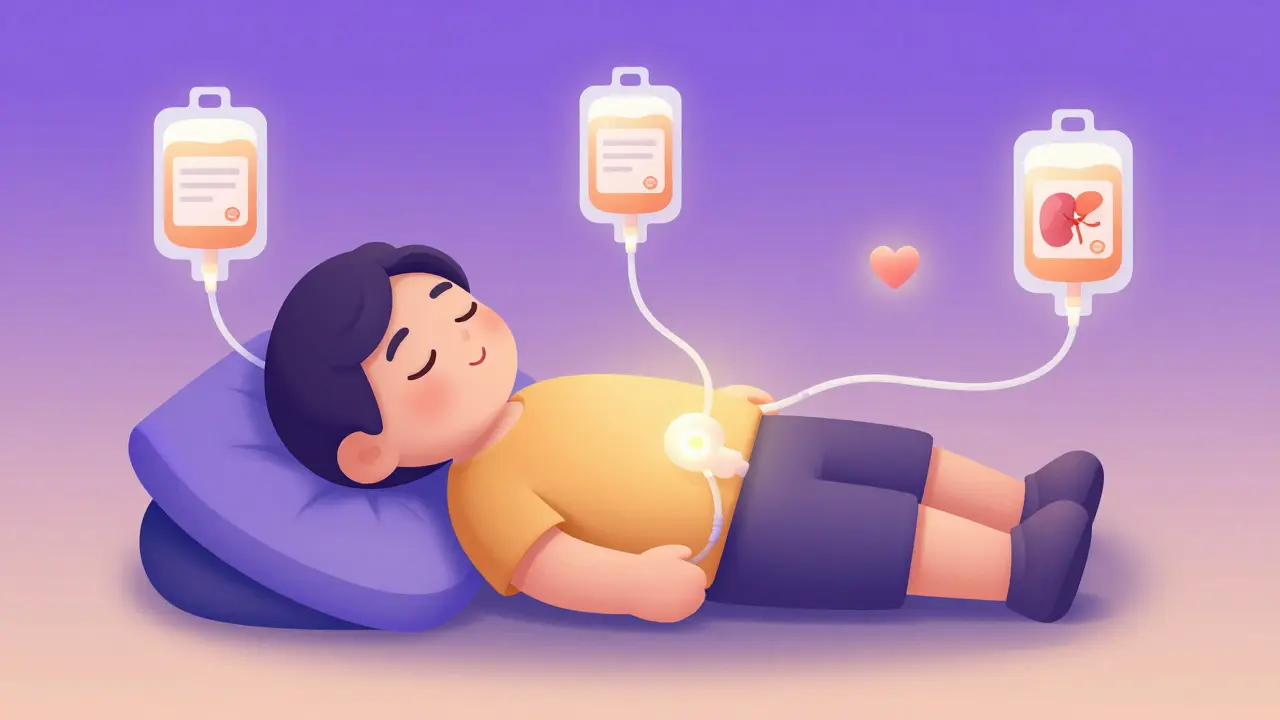
Peritoneal dialysis uses your own belly lining-the peritoneum-as a natural filter. A soft tube called a Tenckhoff catheter is surgically placed in your abdomen. You fill your belly with a special fluid called dialysate, which pulls waste and fluid through the membrane. After 4 to 6 hours, you drain it out and replace it with fresh fluid.
There are two main types. Continuous Ambulatory Peritoneal Dialysis (CAPD) means you do 3 to 5 exchanges manually every day, no machine needed. Automated Peritoneal Dialysis (APD) uses a cycler machine at night while you sleep, doing the exchanges for you.
Unlike hemodialysis, PD works slowly and continuously. You get about 1.7 to 2.1 Kt/V per week, spread out over 24 hours. This means fewer spikes in toxins and fluid between treatments. People on PD often report better blood pressure control and less stress on their heart. Studies show PD also preserves any remaining kidney function longer than hemodialysis.
Which one is better for your body?
A 2023 study from the First People’s Hospital of Tonglu County compared 74 hemodialysis patients and 77 peritoneal dialysis patients over a year. The results were clear: PD patients had significantly lower blood pressure, better heart rate stability, and fewer complications overall. Their levels of parathyroid hormone-a marker for bone and mineral issues-also dropped more.
Why? Because PD doesn’t force your body to handle sudden, large fluid shifts. Hemodialysis removes liters of fluid in just a few hours. That’s a shock to the system. PD removes it slowly, over hours or days. For people with high blood pressure, heart disease, or older adults, this makes a big difference.
But PD isn’t perfect. It doesn’t clear toxins as fast as hemodialysis in a single session. If you’re in acute kidney failure or have massive fluid overload, hemodialysis is faster and safer. PD also carries a risk of peritonitis-an infection in the belly lining. About 0.3 to 0.7 episodes happen per patient per year. That’s low, but it’s still a real danger if hygiene isn’t perfect.
Life on dialysis: freedom vs. routine
If you’re choosing between these two, think about your lifestyle. Hemodialysis means fixed clinic visits. You’re tied to a schedule: Monday, Wednesday, Friday at 9 a.m. Missing a session can make you feel sick. Many patients say they’re wiped out for hours after treatment. One Reddit thread from 2023 showed 97% of 142 HD users complained about rigid schedules.
Peritoneal dialysis gives you control. You can do exchanges at home, at work, even while traveling. No more three-times-a-week trips to a clinic. APD lets you sleep through your treatment. A 2022 National Kidney Foundation survey found 68% of PD users were happier with their flexibility than only 32% of HD users.
But PD demands discipline. You need to wash your hands perfectly before every exchange. You need space to store dialysate bags. You need to be able to handle small tubing and bags without help. If you have arthritis, tremors, or poor eyesight, it can be impossible. About 41% of PD users struggle with manual dexterity, compared to just 9% of HD users.
Cost, training, and accessibility
Hemodialysis is more expensive for clinics and insurers because it requires staff, machines, and space. Peritoneal dialysis costs less overall-no need for a dialysis center, fewer staff hours, less equipment. A 2023 study in the Journal of Peritoneal Therapy and Clinical Practice found PD delivers better value for money and higher early quality-of-life scores.
But here’s the catch: PD needs training. You’ll spend 10 to 14 days learning sterile technique, how to connect lines, spot infections, and manage problems. Most nephrologists in the U.S. aren’t trained to teach it well-only 34% of nephrology fellows get proper PD instruction, according to the American Society of Nephrology.
That’s why PD is underused. In the U.S., only about 12% of dialysis patients use it. In Hong Kong, it’s 77%. In the U.K., it’s 22%. Why? Because those places invest in training, promote home therapies, and reimburse them better. The U.S. Centers for Medicare & Medicaid Services now pushes for 80% of new patients to get education on home dialysis or transplant by 2025. That’s changing things.

Who should pick which?
There’s no one-size-fits-all answer. But here’s a simple guide:
- Choose hemodialysis if: You’re unstable, have severe heart disease, can’t manage sterile technique, have had major abdominal surgeries, or prefer letting professionals handle everything.
- Choose peritoneal dialysis if: You’re medically stable, want to avoid frequent clinic visits, have good manual dexterity, can follow a daily routine, and want to protect your heart and remaining kidney function.
Some people start with hemodialysis and switch to PD later. Others try PD but switch to HD if they get repeated infections. It’s not a forever decision.
What’s changing in 2026?
Technology is improving both options. New PD fluids like icodextrin last longer and don’t damage the peritoneal membrane like glucose-based solutions. Home hemodialysis machines are smaller and easier to use. More people are doing dialysis at night, which mimics natural kidney function better.
But the biggest shift isn’t tech-it’s mindset. Doctors are finally recognizing that PD isn’t a “second choice.” It’s often the better option for long-term health. Studies confirm: PD controls blood pressure better, protects residual kidney function longer, and causes fewer complications. The gap in survival rates between the two has closed. It’s not about which is stronger-it’s about which fits your life.
Final thoughts
Neither hemodialysis nor peritoneal dialysis is a cure. But both give you back time-time with family, time at home, time to live. The best choice isn’t the one doctors recommend most. It’s the one that matches your body, your routine, and your goals. Talk to your nephrologist about your daily life-not just your lab numbers. Ask: Which option lets me feel more like myself? That’s the real question.



RAJAT KD on 10 January 2026, AT 07:01 AM
PD saved my dad's life. No more 3x/week clinic hell. He sleeps through his cycler, cooks dinner, watches baseball. Simple. Effective. Why is this not the default?