
Why Pediatric Dosing Is Different - And Why It Matters
Children aren’t small adults. Their bodies process medicine differently. A dose that’s safe for a 150-pound teen could be deadly for a 20-pound toddler. That’s why confirming the dose on a child’s prescription label isn’t just a good idea - it’s a life-or-death step every parent, caregiver, and healthcare provider must take.
Every year, thousands of children are harmed by medication errors. According to the Institute for Safe Medication Practices, pediatric patients experience medication errors at more than three times the rate of adults. And over half of those errors? They’re dosing mistakes. Most of them happen because the number on the label doesn’t match what the child actually needs.
It’s not about being paranoid. It’s about being smart. A simple misread - like confusing milligrams with milliliters, or using pounds instead of kilograms - can lead to a 2x, 3x, or even 5x overdose. There are real stories: a mother caught a 2.5x overdose because the label said "10 mL" instead of "200 mg." Another parent almost gave their 18-month-old three times the right amount of acetaminophen because they mixed up two different concentrations on the bottle.
What to Look for on the Prescription Label
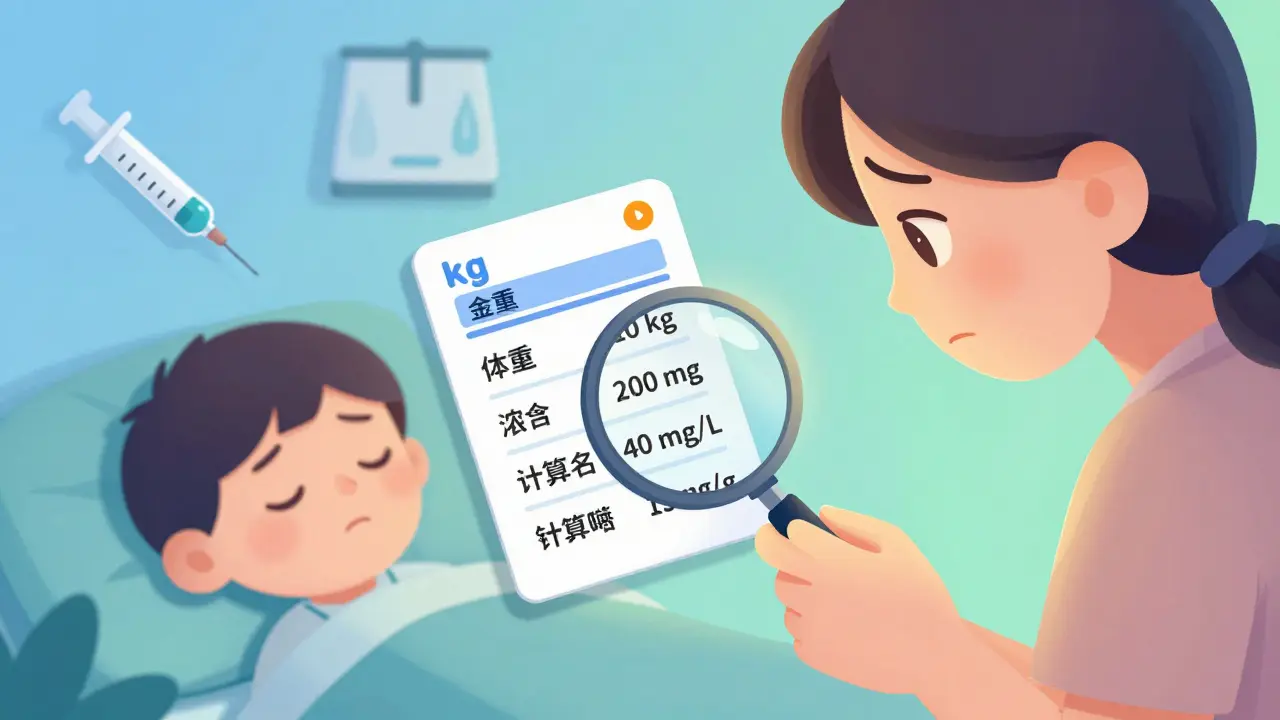
When you pick up your child’s prescription, don’t just grab it and go. Stop. Read. Check. The label should include four non-negotiable pieces of information:
- The child’s weight in kilograms (kg) - not pounds. If it says "22 lb," that’s not enough. It must say "10 kg." (22 lb ÷ 2.2 = 10 kg). If it’s missing, ask for it.
- The dose in milligrams (mg) - not milliliters (mL). The label should say "200 mg," not "10 mL." Volume alone tells you nothing about how much medicine is actually in there.
- The concentration - this is often printed as "mg/mL." For example, amoxicillin might be 40 mg/mL or 80 mg/mL. If it’s not listed, don’t leave until you get it.
- The calculated dose per kg - it should say something like "40 mg/kg/day" or "15 mg/kg/dose." This is your safety net. If it’s not there, the prescription isn’t complete.
These aren’t suggestions. They’re requirements under the FDA’s 2021 Drug Safety Communication and the American Academy of Pediatrics’ 2024 policy update. If your pharmacy didn’t include them, ask them to reprint the label. You have the right to this information.
How to Verify the Dose Yourself - Three Simple Steps
Even if the label looks right, always verify it yourself. Here’s how:
- Convert weight to kilograms - If your child weighs 33 pounds, divide by 2.2: 33 ÷ 2.2 = 15 kg. Don’t guess. Use a calculator. This step alone fixes 22.4% of dosing errors, according to the Pennsylvania Patient Safety Reporting System.
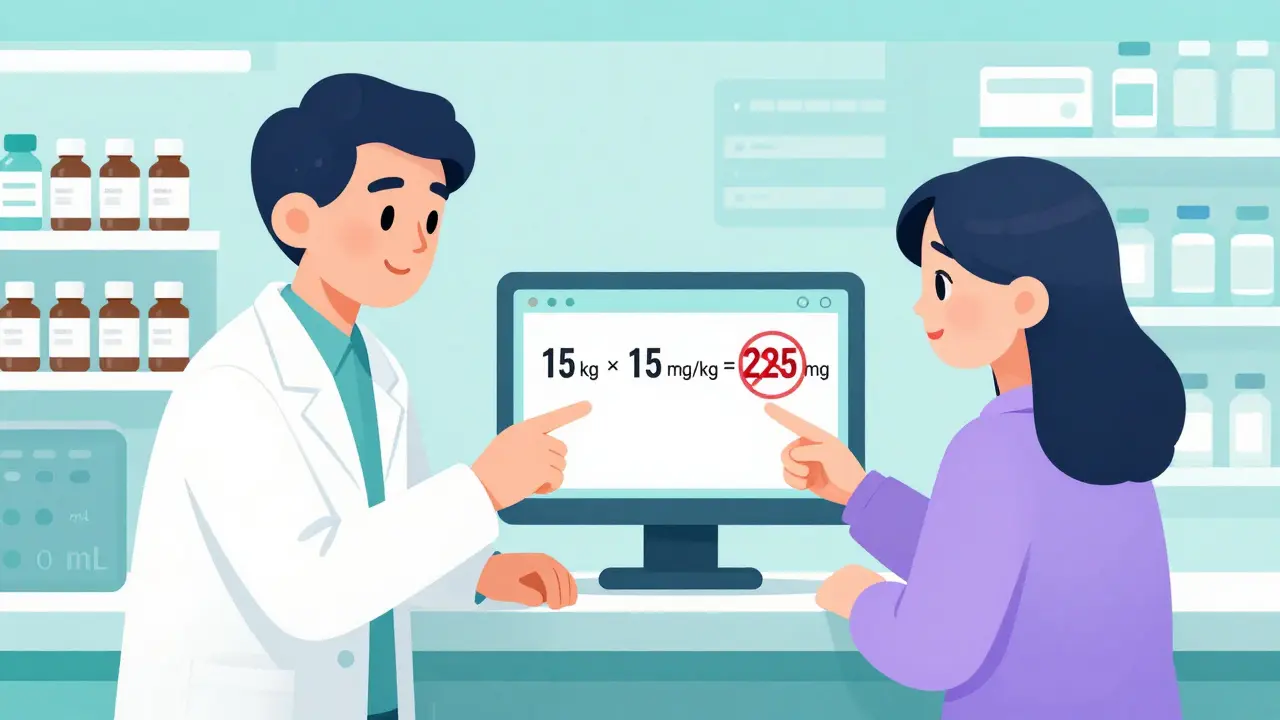
- Calculate the dose - Find the prescribed dose per kg. If the label says "15 mg/kg/dose" and your child weighs 15 kg, then 15 × 15 = 225 mg per dose. That’s the number you’re checking against.
- Match the dose to the volume - Now check the concentration. If it’s 160 mg/5 mL, that’s 32 mg per mL. So for 225 mg, you need 225 ÷ 32 = 7.03 mL. That’s roughly 7 mL on a syringe. If the label says "7 mL," it’s correct. If it says "10 mL," it’s wrong.
Use the Mosteller formula only if it’s for chemotherapy - it’s too complex for regular meds. For everything else, stick to mg/kg. Clark’s rule (based on adult dose) is outdated and risky.
Watch Out for These Common Mistakes
Even experienced parents and nurses make the same mistakes over and over. Here are the top three:
- Confusing mg with mL - This is the #1 error. "10 mL" doesn’t mean "10 mg." A 10 mL dose of a 40 mg/mL solution is 400 mg. A 10 mL dose of an 80 mg/mL solution is 800 mg. That’s a 100% overdose difference.
- Using the wrong concentration - Liquid amoxicillin comes in multiple strengths: 40 mg/mL, 60 mg/mL, 80 mg/mL. If you switch brands or refill at a different pharmacy, the concentration might change. Always check the bottle label and the prescription label together.
- Assuming "smaller number = safer" - A 5 mL dose might seem tiny compared to an adult’s 30 mL dose. But if your child weighs 10 kg and needs 15 mg/kg, then 5 mL of 80 mg/mL = 400 mg - which is exactly right. Don’t second-guess the math because it looks small.
One nurse with 12 years in pediatric ICU told me: "The most dangerous moment is when a parent says, ‘This can’t be right - it’s too little.’ And it actually is right. That’s when you need the numbers, not your gut."
What the Pharmacist Should Be Doing
Pharmacists aren’t just filling prescriptions - they’re safety checks. The American Society of Health-System Pharmacists (ASHP) requires dual verification for every pediatric dose. That means two people must independently calculate the dose before it’s dispensed.
Ask your pharmacist: "Did you verify the dose based on my child’s weight?" They should be able to show you:
- The weight in kg
- The calculated dose in mg
- The concentration used
- The final volume in mL
They should also write on the label: "Ordered: 15 mg/kg/dose, Verified: 14-16 mg/kg/dose." If they can’t do that, ask why. You’re not being difficult - you’re preventing a mistake.
Technology Can Help - But Don’t Rely on It Alone
Hospitals and pharmacies use systems like EPIC and Cerner that auto-calculate doses and flag errors. DoseSpot’s AI tool checks against 15,000+ guidelines and catches 99.2% of mistakes. But here’s the catch: these systems only work if the input is right.
If the doctor enters "40 lb" instead of "18 kg," the system might still calculate a wrong dose. If the concentration isn’t selected correctly, the math fails. That’s why technology is a tool - not a replacement for human verification.
Smart pumps and connected scales (like Philips’ IntelliSpace platform launching in 2024) will help, but they’re not everywhere yet. Until then, you’re the last line of defense.

What to Do If Something Feels Off
If the dose seems too high, too low, or just doesn’t make sense - don’t give it. Don’t guess. Don’t assume. Do this:
- Call the prescribing doctor or pharmacy. Say: "I’m checking the dose for my child. The label says 10 mL of 80 mg/mL. My child weighs 15 kg. The prescription says 15 mg/kg. Is this correct?"
- Use the FDA’s Safe Use of Pediatric Liquid Medicines guide. Ask: "What is the exact dose in milligrams? Is this dose appropriate for my child’s current weight? Can you show me how to measure this with the syringe?"
- If you’re still unsure, go to a different pharmacy. Sometimes a second pair of eyes catches what the first missed.
One mother in Ohio saved her 2-year-old from a 3x overdose by checking the acetaminophen concentration against the manufacturer’s chart. The label said "160 mg/5 mL," but the bottle she had at home was labeled "80 mg/0.8 mL." She caught it before giving the dose.
Final Checklist: Before You Give the Medicine
Use this before every dose:
- ✅ Child’s weight is listed in kg (not lbs)
- ✅ Dose is listed in mg (not mL)
- ✅ Concentration (mg/mL) is clearly printed
- ✅ Calculated dose (mg/kg) matches the label
- ✅ Volume (mL) matches the dose and concentration
- ✅ Syringe or measuring cup matches the prescribed volume
- ✅ You’ve asked the pharmacist: "Did you verify this?"
If even one box is unchecked - stop. Call. Double-check. It’s not a waste of time. It’s the difference between healing and harm.
Why This Matters Beyond the Label
This isn’t just about one pill or one liquid dose. It’s about building a culture of safety. Children’s hospitals have standardized protocols - 86% of them do. But only 43% of general hospitals do. That means if your child goes to a community ER or clinic, the system might not be as strong.
That’s why your role matters. You’re not just a parent. You’re a safety officer. You’re the one who sees the label, holds the syringe, and makes the final decision. And you’re not alone. The FDA, ASHP, and AAP have your back - they’ve set the rules. Now it’s your turn to use them.



Wendy Lamb on 2 February 2026, AT 23:59 PM
My kid’s last prescription had the weight in pounds and no concentration listed. I called the pharmacy and they printed a new label within 10 minutes. They were actually grateful I asked. Turns out, they’re supposed to do this by law.