

When you start a new medication, it’s normal to wonder: Is this feeling caused by the drug, or is it something else? Dizziness after taking blood pressure pills? Nausea after antibiotics? A rash that showed up two days after starting a new supplement? These aren’t just annoyances-they could be signs of a drug reaction. But without clear records, doctors can’t tell if the problem is the medicine, another health issue, or just bad luck. That’s where a symptom diary comes in. It’s not fluff. It’s your best tool to get the right help, fast.
Why a Symptom Diary Matters
Most people rely on memory when they describe how they feel to their doctor. But memory is unreliable. Studies show that after 48 hours, people forget up to 60% of symptom details. If you say, “I felt weird last week,” your doctor has no way to know if it happened 10 minutes after your pill or 12 hours later. That gap changes everything. A symptom diary removes guesswork. It shows patterns. It proves timing. And when you can show your doctor that every time you took drug X, you got dizzy exactly 45 minutes later, they can’t ignore it. In one real case, a patient kept getting dizzy and nearly crashed their car. Their neurologist thought it was stress. Only after they showed a 14-day diary linking dizziness to a specific dose of levodopa did the doctor adjust the treatment-within 48 hours. That’s the power of data.What to Record in Your Diary
A good symptom diary isn’t just a journal. It’s a clinical tool. The National Institute on Aging and the FDA agree: there are nine key pieces of information you need to capture every time you take a medication or notice a new symptom.- Date and time of medication intake - down to the minute. Use your phone’s clock. Don’t guess.
- Exact dosage and route - Was it 50 mg tablet? 10 mg liquid? Subcutaneous injection? Write it exactly as it appears on the label.
- All other medications and supplements - Including ibuprofen, melatonin, fish oil, or herbal teas. Many reactions happen because of combinations, not single drugs.
- What you felt - Not “I felt bad.” Say: “Sharp pain in left chest, 6/10 intensity, started 35 minutes after pill.” Use your own words. Be specific.
- Where the symptom happened - Head? Stomach? Skin? Joint? Location helps identify the type of reaction.
- When the symptom started after taking the drug - Did it hit 10 minutes later? 6 hours? This timing is critical for determining if the drug caused it.
- How long it lasted - 20 minutes? All day? Did it come and go?
- What you did to fix it - Did you lie down? Take antihistamines? Drink water? Did it help?
- Environmental factors - Were you stressed? Hot? Exercising? Eating? Sleep-deprived? These can mix with drugs and make reactions worse.
Don’t just write “headache.” Write: “Throbbing headache, right temple, started 22 min after lisinopril, lasted 2.5 hours, eased with 600mg ibuprofen and dark room.” That’s the kind of detail that changes outcomes.
How to Rate Your Symptoms
Not all symptoms are equal. A mild rash is different from swelling that blocks your airway. To avoid confusion, use a simple scale called CTCAE v5.0 (Common Terminology Criteria for Adverse Events). It’s used by hospitals worldwide.- Grade 1 (Mild) - Slight discomfort. Doesn’t interfere with daily life. (e.g., mild dry mouth)
- Grade 2 (Moderate) - Noticeable. Limits some activities. (e.g., nausea that makes you skip meals)
- Grade 3 (Severe) - Prevents normal activity. Needs medical attention. (e.g., vomiting all day, high fever)
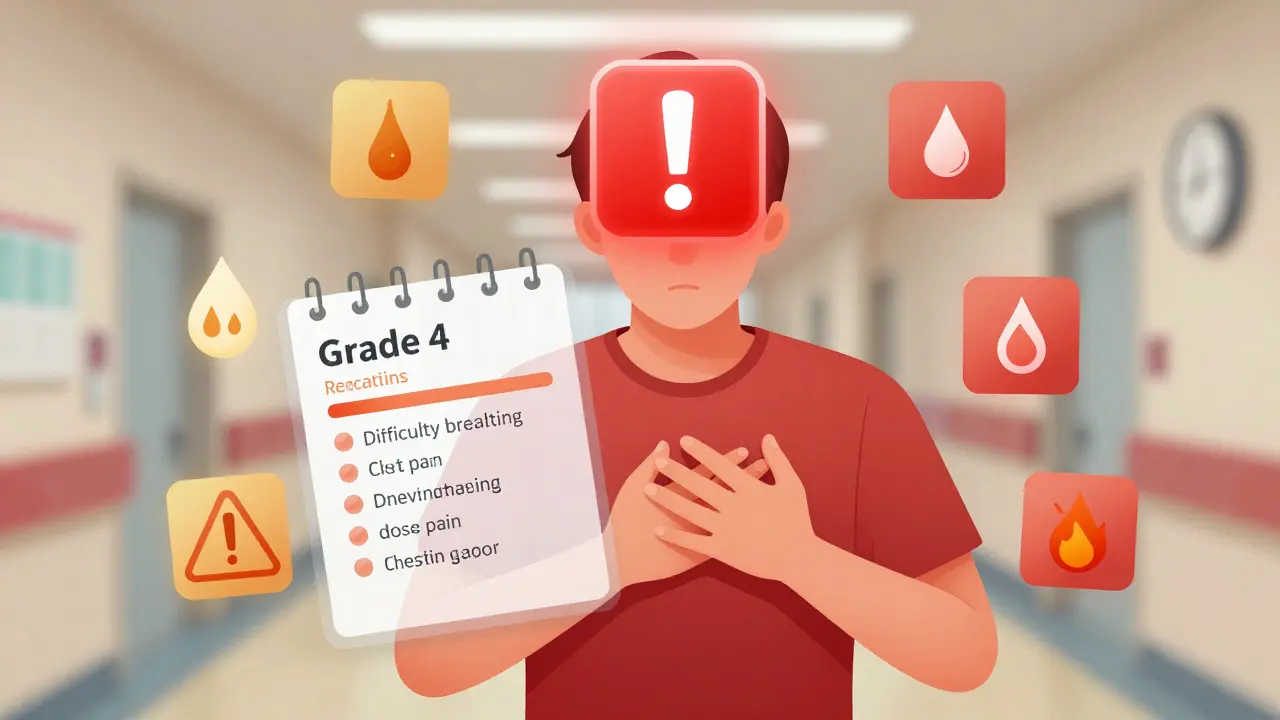
- Grade 4 (Life-threatening) - Emergency. (e.g., trouble breathing, chest pain)
- Grade 5 (Death) - Obviously, don’t wait for this.
Write the grade next to each symptom. It helps your doctor know how urgent this is. A Grade 3 reaction needs immediate review. A Grade 1 might just need monitoring.
Use an App or Paper? Here’s the Real Answer
You don’t need fancy tech. But if you’re serious about this, apps win. Paper diaries? 57% of people quit within 72 hours. Why? Too much writing. Too easy to forget. Too hard to spot patterns. Apps like Medisafe, CareClinic, and MyTherapy are designed for this. They:- Send reminders when it’s time to take your pill or log a symptom
- Auto-timestamp entries
- Generate charts showing when symptoms spike after doses
- Let you add photos (critical for rashes or swelling)
- Export PDFs to email to your doctor
One study found patients using apps were 2.5 times more likely to keep their diary for more than 30 days. And if you’re in a clinical trial, the FDA requires apps to meet 21 CFR Part 11 standards-meaning data can’t be edited after entry. That’s serious. That’s trustworthy.
Still prefer paper? Use a printed template with checkboxes for common symptoms (nausea, rash, dizziness, fatigue). Pre-printed forms cut completion time by 67%. No guesswork. Just fill in the boxes.

What NOT to Document
Don’t turn this into a full health journal. You’re not tracking your sleep quality or whether you had a good day. Focus only on what matters: drug → symptom → timing.Many people waste time logging every little thing: “I had coffee,” “I slept 7 hours,” “I felt a little tired.” That’s noise. It hides the real signal. A 2022 study found 41% of diaries had so much irrelevant detail that doctors missed serious reactions for over 3 days.
Only record symptoms that are:
- Unexpected (not listed on the drug’s side effect sheet)
- Unusual for you (e.g., you’ve never had rashes before)
- Worse than expected (e.g., mild drowsiness becomes confusion)
- Linked to a specific dose or time
Don’t log every headache. Log the one that came on after your first dose of a new statin. That’s the one that matters.
When and How to Review
Don’t wait until your next appointment. Review your diary weekly. Look for patterns. Does the rash always appear after you take the morning pill? Does the dizziness happen only when you stand up? That’s your clue.Bring your diary to every doctor visit-even if you think nothing’s wrong. Show it. Say: “I’m tracking possible reactions. Here’s what I’ve noticed.” Most doctors will be impressed. They’ve seen too many patients say, “I think it was the medicine,” with no proof.
Some pharmacies now offer free 15-minute diary review sessions with pharmacists. Use them. They know which symptoms are red flags. One study showed pharmacist-led reviews cut response time to serious reactions by over 5 days.
Red Flags That Need Immediate Action
Some reactions are dangerous. Don’t wait. If you see any of these, call your doctor or go to the ER:- Swelling of face, lips, tongue, or throat
- Difficulty breathing or wheezing
- Fast heartbeat, chest pain, or fainting
- High fever with rash or blistering skin
- Yellowing skin or eyes (jaundice)
- Severe abdominal pain with vomiting
These aren’t side effects. They’re emergencies. Your diary won’t stop them-but it will help doctors treat you faster and prevent others from getting hurt.
Real Stories from People Who Did It Right
On Reddit’s r/Pharmacy, over 1,200 people shared their experiences. 68% said their diary improved doctor visits. 42% got their medication changed because of it. One woman had chronic fatigue after starting an antidepressant. Her doctor said it was depression. She kept a diary for 10 days. The pattern: fatigue spiked 2 hours after each dose. She showed it. They switched meds. Within a week, her energy returned. Another man had a rash after a new blood pressure drug. He took photos every day. The photos showed the rash spread exactly where the pill touched his skin. Turns out, it was a contact reaction-not a systemic allergy. That changed his treatment completely.What If You Forget to Log One Day?
Don’t panic. Don’t throw it out. Just note: “Missed entry on [date]. Felt normal.” Honesty matters more than perfection. The goal isn’t to have a flawless log. It’s to have enough data to spot real patterns. Missing one day won’t ruin it. Missing every day will.Why This Is the Future of Medicine
The FDA is investing $12.3 million over the next few years to make patient diaries standard in every clinic. Why? Because they work. In oncology trials, 92% of patients use diaries. In mental health, only 48% do. Why the difference? Because cancer drugs have brutal side effects-and patients know their data saves lives. New AI tools are now being tested to scan your diary and flag possible reactions before your doctor even sees you. Google’s Verily platform can predict drug reactions with 89% accuracy from structured diary data. This isn’t sci-fi. It’s coming.You’re not just keeping a diary. You’re helping science. You’re helping yourself. And you’re helping the next person who takes this same drug.


Nancy Kou on 21 December 2025, AT 03:06 AM
This is the kind of practical advice that actually saves lives. I used to wing it with my meds until I started tracking symptoms like this after a bad reaction to metoprolol. Now I use CareClinic and it’s changed everything. No more guessing games with doctors.