
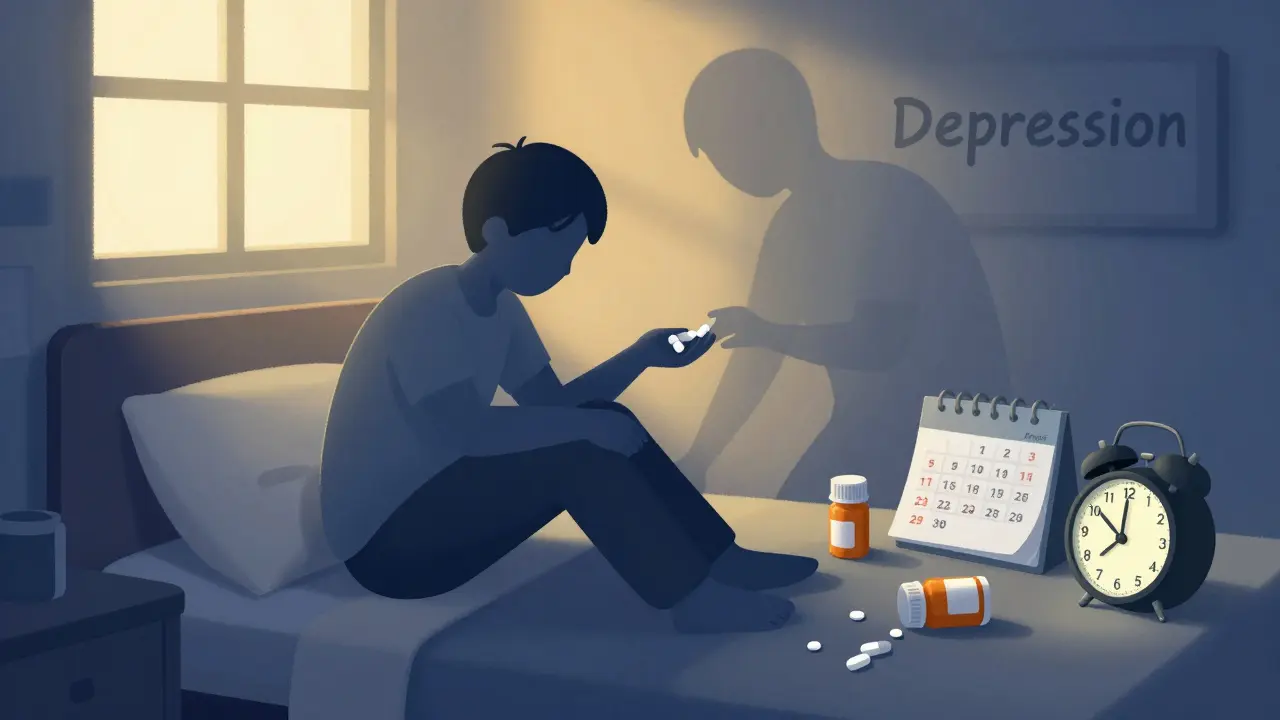
When someone is struggling with depression, taking pills every day doesn’t just become harder-it often feels impossible. It’s not laziness. It’s not rebellion. It’s the illness itself quietly stealing the energy, focus, and motivation needed to stick to a treatment plan. If you’re a clinician, a caregiver, or even someone managing their own health, recognizing how depression quietly undermines medication adherence can make all the difference between recovery and decline.
Depression Doesn’t Just Affect Mood-It Breaks Routines
Depression doesn’t just make you feel sad. It rewires your brain’s ability to plan, remember, and follow through. A 2022 systematic review of 31 studies found that depressed patients with heart failure were 2.3 times more likely to miss their medications than those without depression. This wasn’t random. The study adjusted for age, education, comorbidities, and even heart function class-and the link still held strong. For patients on ACE inhibitors, beta-blockers, or mineralocorticoid receptor antagonists, every point increase in depression severity meant a small but measurable drop in adherence. That’s not coincidence. That’s clinical reality.It’s the same story in diabetes, hypertension, HIV, and even asthma. Depression doesn’t care what condition you’re treating-it just wants to stop you from taking the pills that keep you alive.
How to Spot the Signs: Real-World Patterns
You won’t always hear a patient say, “I’m too depressed to take my meds.” Instead, look for patterns:- Missing doses for several days in a row, then suddenly taking them all at once.
- Running out of medication weeks before refill date, with no explanation.
- Consistently skipping morning or evening doses-the ones tied to routine.
- Reporting side effects that don’t match clinical records (e.g., “I feel so tired” when they’re on a non-sedating drug).
A study from Cambridge tracked 83 patients with major depressive disorder. Only 6% scored high on the Morisky Medication Adherence Scale (MMAS-8). That’s 5 out of 83 people who took every pill, every time. The rest? 39.8% were non-adherent (score < 6), and 54.2% were only moderately adherent (score < 8). That’s not just forgetfulness. That’s depression in action.
And it’s not just about forgetting. The same study found non-adherent patients had significantly higher anxiety levels. Depression doesn’t work alone. It teams up with anxiety, stress, and fatigue to create a perfect storm for missed doses.
Side Effects Feel Worse When You’re Depressed
Here’s the cruel twist: depression doesn’t just make you miss pills-it makes side effects feel unbearable.Patients on SSRIs like citalopram or sertraline often quit because of drowsiness, dry mouth, or weight changes. But here’s the catch: in someone with depression, those same side effects feel more intense. A 2014 study from the Canary Islands used the GARSI scale to measure adverse drug reactions. Non-adherent patients scored 0.87. Adherent ones? 0.71. The difference was small, but statistically significant. Why? Because depression amplifies discomfort. A dry mouth isn’t just annoying-it’s proof, in the depressed mind, that the drug is “hurting” them.
Same with amitriptyline. In Ethiopia, over half of patients stopped taking it because of weight gain or constipation. Not because it didn’t work. Because they felt worse taking it than they did before.
Use These Tools to Recognize the Problem
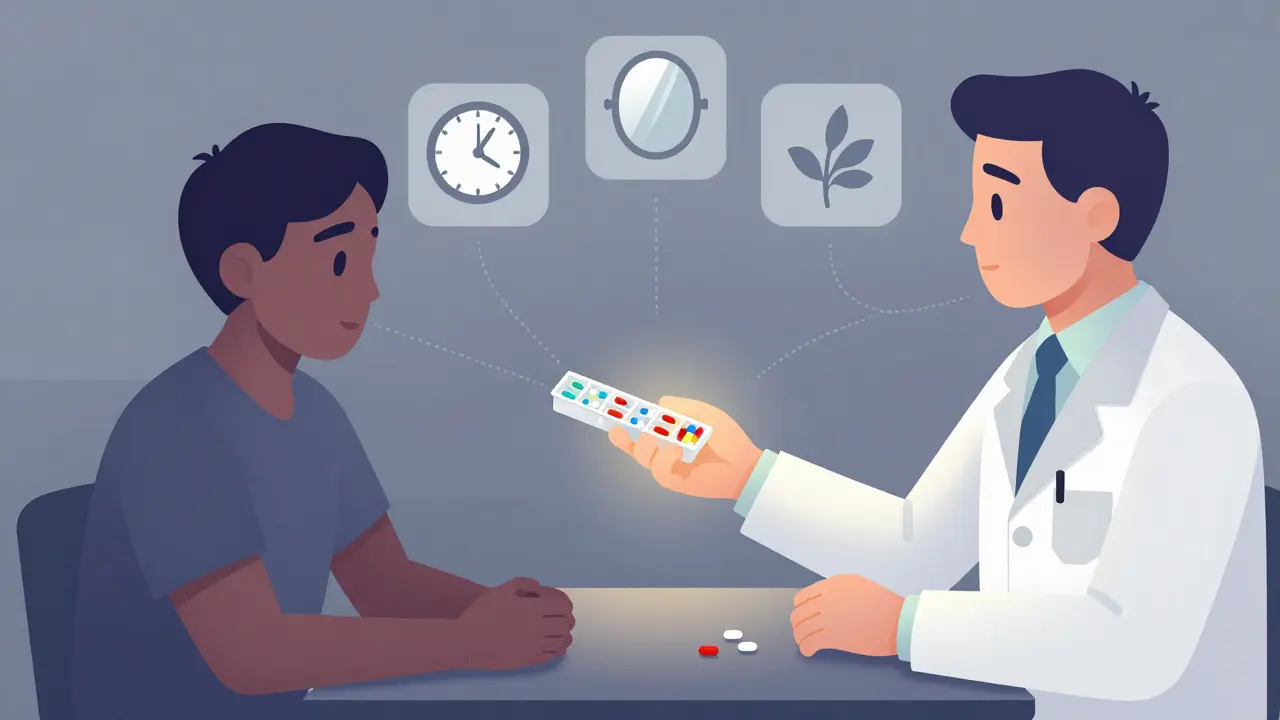
You don’t need guesswork. There are validated tools that work.The PHQ-9 is the simplest. A score of 10 or higher means moderate to severe depression-and that’s your red flag. For every 5-point increase on the PHQ-9, adherence drops by about 23%. That’s not theoretical. That’s predictive.
The MMAS-8 asks eight simple questions: Did you forget? Did you stop because you felt worse? Did you skip doses because you were afraid? A score below 6 means non-adherent. Below 8 means you’re not fully on track.
Combine them. A 2021 study showed that using PHQ-9 + MMAS-8 together improved prediction accuracy by 37%. That’s huge. You’re not just asking “Are you depressed?” and “Are you taking your meds?” You’re connecting the dots.
Early Warning Signs You Can’t Ignore
The STAR*D trial found something chilling: if a patient misses more than 20% of their doses in the first two weeks of treatment, they’re 4.7 times more likely to have treatment failure. That’s not a coincidence. That’s a pattern.That first week is critical. If someone skips doses early on, don’t assume they’re “non-compliant.” Assume they’re depressed. Ask. Listen. Don’t judge. Offer support. Maybe the problem isn’t the pill-it’s the person’s brain.
What Works: Real Strategies That Help
The MAPDep study in Spain didn’t just measure the problem. It fixed it. They created a simple system: patients and doctors met weekly to review medication logs, side effects, and mood. No fancy tech. Just conversation. Result? Adherence jumped by 28.5% over a year.Another approach? “Side effect mapping.” Have patients write down their daily mood and side effects. Over time, patterns emerge. “I feel worse every time I take this pill” becomes “I feel worse on Tuesdays, and I’m more depressed on Tuesdays.” Suddenly, you’re not treating a missed pill-you’re treating a mood-cycle.
And yes, tech is helping. A 2024 study found smartphone apps that track mood and medication intake predicted adherence lapses 72 hours in advance with 82% accuracy. Not perfect. But better than waiting for someone to show up at the clinic with an empty pill bottle.
It’s Not About Compliance-It’s About Connection
The American Heart Association now recommends screening all heart failure patients with the PHQ-2 at every visit. Why? Because depression doesn’t announce itself. It hides in silence. And silence kills.When a patient stops taking their meds, the instinct is to blame them. “Why won’t they just follow the plan?” But the real question is: “What’s stopping them?”
Depression doesn’t care if you’re smart, rich, or well-informed. It doesn’t care if you have insurance or a supportive family. It only cares if you have the energy to care. And when that energy is gone, even life-saving pills feel like too much.
Recognizing this isn’t about being a better doctor. It’s about being a better human. You don’t need a PhD to ask: “Have you been able to take your pills lately?” You just need to care enough to listen.
Can depression cause someone to stop taking their medication even if it’s working?
Yes. Depression doesn’t just make people forget-they often believe the medication is causing harm, even when it’s helping. Side effects like fatigue or weight gain feel overwhelming when you’re depressed, leading patients to stop treatment despite clear clinical benefits. Research shows the subjective experience of side effects is amplified in depression, making patients more likely to discontinue effective drugs.
What’s the most reliable tool to measure medication adherence in depressed patients?
The Morisky Medication Adherence Scale (MMAS-8) is the gold standard. It’s an 8-question survey that identifies non-adherence (score < 6), moderate adherence (score < 8), and high adherence (score = 8). Used alongside the PHQ-9 for depression screening, it’s been shown to predict adherence problems with 37% greater accuracy than either tool alone.
How does depression affect adherence to cardiac medications specifically?
Depression significantly reduces adherence to heart failure medications like ACE inhibitors, beta-blockers, and mineralocorticoid receptor antagonists. A 2022 review found depressed patients were 2.3 times more likely to miss doses. For every one-point increase in depression severity, adherence dropped by 4% to 6% for these critical drugs. This isn’t random-it’s a direct, measurable risk.
Is non-adherence always intentional in depressed patients?
No. While some patients intentionally stop due to side effects or beliefs, many simply lack the cognitive energy to remember, plan, or act. Depression impairs memory, concentration, and decision-making-making complex medication routines feel impossible. It’s not defiance. It’s neurological fatigue.
Can screening for depression improve medication adherence?
Yes. Studies show that integrating PHQ-9 screening with MMAS-8 adherence tracking leads to better outcomes. One 2024 study found that collaborative care models using these tools improved depression symptoms and mental quality of life over 12 months. When clinicians recognize the link, they can adjust treatment-switching meds, adding support, or simplifying regimens-leading to higher adherence and better health.




John Smith on 26 February 2026, AT 19:14 PM
So let me get this straight-depression makes people forget pills but we’re supposed to be shocked?Newsflash: humans aren’t robots. You think a 72-year-old with heart failure and three kids and a dog and a job and a dead marriage is gonna remember a blue pill at 7am when their brain’s been turned to wet sand? This isn’t a medical paper. It’s a cry for better systems. Or maybe just less judgment.
Also why is everyone acting like this is new? My grandma took 14 pills a day and forgot half. She didn’t need a PHQ-9. She needed someone to show up with a pill organizer and a cup of tea. But nope. We need a 37% accuracy stat to validate human suffering. Pathetic.