
Every year, millions of people in the U.S. take medications past their expiration dates - not because they’re reckless, but because they don’t know how to track them. You might have a drawer full of old pills, a cabinet with half-used bottles, or a medicine box that hasn’t been checked in over a year. The problem isn’t just waste - it’s safety. Taking an expired antibiotic could mean your infection doesn’t clear. Using an old EpiPen might not stop a life-threatening reaction. And insulin that’s lost its potency? That can send blood sugar spiraling out of control.
Creating a medication expiration review schedule isn’t about being obsessive. It’s about being smart. It’s the difference between guessing whether your meds are still good and knowing for sure. And the good news? You don’t need fancy tech or a pharmacy degree to do it. Just a system, a little time, and some basic tools.
Why You Need a Review Schedule
The FDA says expiration dates aren’t arbitrary. They’re based on real testing: how long a drug stays stable, potent, and safe under normal storage conditions. But here’s the twist - many drugs stay effective long after that date. A 2015 Mayo Clinic study found 90% of tested medications were still potent 15 years past expiration - if stored properly.
So why do we still throw them out? Because storage conditions at home aren’t perfect. Heat, humidity, sunlight, and even moisture from the bathroom sink can break down pills and liquids faster than labs predict. And some meds? They degrade fast. Nitroglycerin for chest pain. Liquid antibiotics. Insulin. Epinephrine. If these lose strength, they won’t work when you need them most.
According to the Agency for Healthcare Research and Quality, over half of American adults take at least one prescription drug. And 76% of home medication errors involve expired drugs - especially asthma inhalers, EpiPens, and birth control. A simple review schedule cuts that risk dramatically.
Step 1: Gather Everything
Start by pulling out every pill, liquid, patch, inhaler, and injection you have. Don’t skip the ones you haven’t used in years. Don’t assume the bottle in the back of the cabinet is still okay. Look for:
- Prescription bottles
- Over-the-counter pain relievers
- Vitamins and supplements
- Emergency meds like EpiPens or nitroglycerin
- Insulin pens or vials
- Liquid antibiotics or eye drops
Check the label for the expiration date. If it’s faded, illegible, or missing - mark it as expired. If it’s a repackaged pill (like from a pharmacy blister pack), look for the fill date. Most repackaged meds last one year from that date.
Write down each item’s:
- Name
- Strength (e.g., 10 mg, 500 mg)
- Expiration date
- Quantity left
- Storage location
Use a notebook, spreadsheet, or app. The goal is to have a single source of truth.
Step 2: Sort by Risk Level
Not all meds need the same attention. Group them:
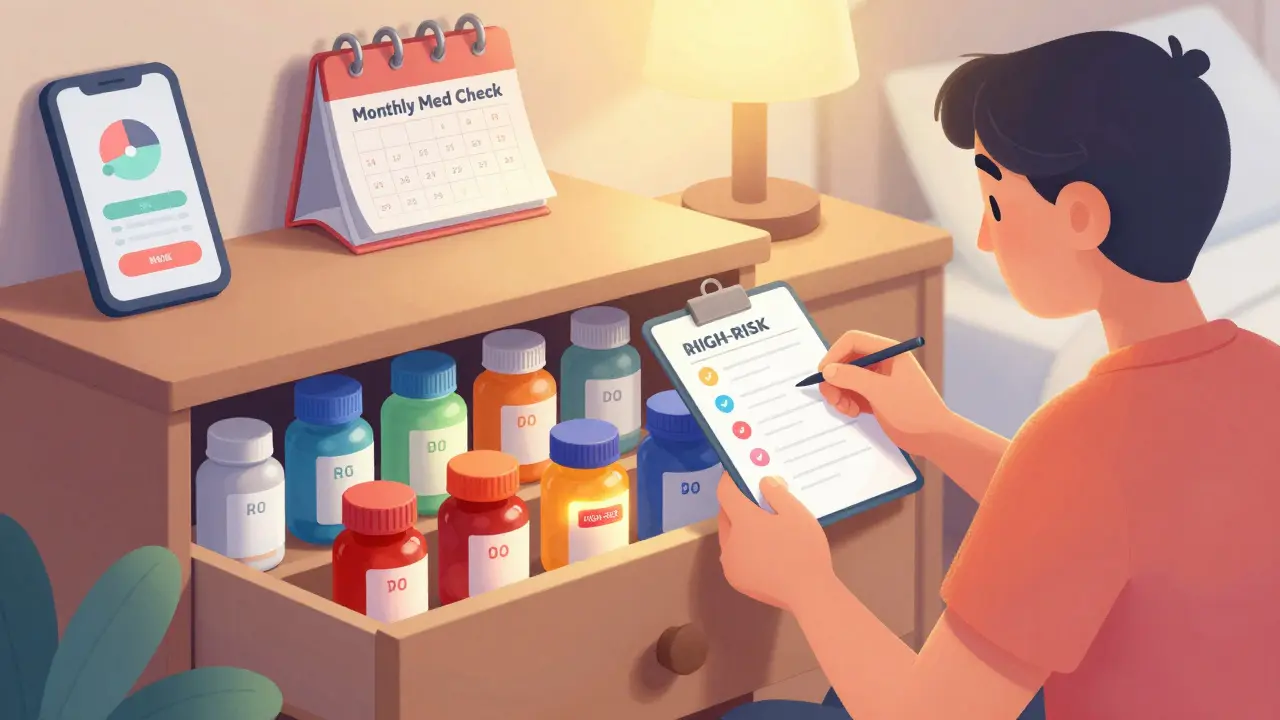
- High-risk (check monthly): Insulin, nitroglycerin, epinephrine, liquid antibiotics, eye drops, and any meds that must be refrigerated. These degrade fastest. A 2020 NIH study found insulin can lose up to 10% potency within weeks after expiration.
- Medium-risk (check quarterly): Blood pressure pills, diabetes meds, antidepressants, inhalers, and birth control. Even if they seem fine, losing potency can cause dangerous fluctuations.
- Low-risk (check twice a year): Pain relievers (ibuprofen, acetaminophen), antihistamines, antacids, and most supplements. These are generally stable longer - but still check.
Mark your calendar. Set a recurring reminder on your phone. Put sticky notes on your fridge. Whatever works. The key is consistency.
Step 3: Build Your Review Routine
Here’s a simple monthly checklist:
- Look at each high-risk med. Is it discolored? Smelly? Cloudy? Cracked? Discard it.
- Check the expiration date. If it’s within 30 days, plan to refill soon.
- For refrigerated meds, confirm they’re still in the fridge - not left on the counter.
- Update your log. Cross off anything you’ve used or tossed.
For quarterly reviews, repeat the same steps, but include medium-risk items. Add a visual check: hold pills up to the light. Are they chalky? Flaking? Don’t take them.
For twice-yearly reviews, go through everything. Ask: Have I used this in the last 6 months? If not, do I still need it? Talk to your pharmacist. They can tell you if it’s safe to keep.

Step 4: Use Tools That Actually Help
You don’t need to remember everything. Tools make it easier.
- Apps: Medisafe and Medisafe Sync send automatic alerts. They sync with your pharmacy and even remind you when to refill.
- Pill organizers: Hero Health or MedMinder have built-in expiration tracking. They cost $300-$500, but if you take 5+ pills daily, they pay for themselves in safety.
- Simple paper log: Free template from the National Council on Aging. Print it. Tape it to your fridge. Update it every time you open a new bottle.
- Color coding: Use red stickers on meds expiring in 60 days. Yellow for 30 days. Green for everything else. A visual cue beats a calendar alert every time.
One user in Perth told me she started using a red marker on her pill bottles. Every time she opened a new bottle, she wrote the expiration date on the front. Within three months, she stopped wasting $150/month on unused meds.
What to Do With Expired Meds
Don’t flush them. Don’t toss them in the trash. Don’t give them to someone else.
Use a take-back program. In Australia, the Medicine Disposal Program runs at over 3,000 pharmacies. Just drop off expired, unwanted, or unused meds. No questions asked. Many pharmacies offer this free.
If you can’t get to one, mix pills with coffee grounds or cat litter in a sealed bag before tossing. This keeps pets and kids from finding them.
For injectables like insulin or EpiPens, remove the needle and dispose of it in a sharps container. Many pharmacies give these out free.
Common Mistakes (And How to Avoid Them)
- Mistake: Assuming ‘manufacture date’ is the same as ‘expiration date.’ Solution: Always look for ‘EXP’ or ‘Expires.’
- Mistake: Keeping meds in the bathroom. Solution: Store them in a cool, dry place - a bedroom drawer, not above the sink.
- Mistake: Ignoring storage instructions. Solution: If it says ‘refrigerate,’ keep it cold. If it says ‘avoid heat,’ don’t leave it in the car.
- Mistake: Waiting until you’re out of pills to refill. Solution: When you have two weeks left, call for a refill. Don’t risk running out.
A 2023 Pharmacy Times survey found 43% of people take expired meds because they ‘look fine.’ But pills don’t show degradation like food does. You can’t smell a weak antibiotic. You can’t see a failing EpiPen.

When to Call Your Pharmacist
You don’t have to guess. Pharmacists are trained to help.
Call them if:
- You’re unsure whether a med is still safe
- You’ve been using an expired med and feel off
- You’re switching from one brand to another
- You’re taking 5+ medications
Many pharmacies now offer free medication reviews. They’ll look at your whole list, check for interactions, and tell you what’s expired or unnecessary. It’s free. It’s fast. And it could save your life.
What Happens If You Don’t Have a System?
Let’s say you’re 72, take five meds daily, and haven’t checked your pills in two years. You grab what looks like your blood pressure pill - but it’s an old antibiotic. You take it. Nothing happens. So you keep taking it. Weeks later, you get a stomach infection. Your doctor says, ‘This isn’t responding to antibiotics.’ Why? Because the ones you’ve been taking lost their potency months ago.
That’s not rare. It’s common.
The FDA estimates 125,000 deaths each year in the U.S. are linked to improper medication use. Most of them involve expired, misused, or forgotten drugs.
You don’t need to be perfect. Just consistent. One review a month. One log. One habit. That’s all it takes.
Final Tip: Make It a Family Habit
Don’t do this alone. If you care for an aging parent, partner, or child with chronic illness, include them. Put the log on the fridge. Set a shared calendar alert. Talk about it at dinner.
One family in Perth started a ‘Med Check Night’ every first Sunday. They sat together, sorted pills, and called the pharmacist. Within six months, they cut their medication waste by 60% and avoided two hospital visits.
It’s not about control. It’s about care.



Dylan Patrick on 12 March 2026, AT 01:51 AM
Just set up a little sticky note on my fridge with red/yellow/green dots for my meds. Changed my life.
No more guessing. No more panic when I run low.
One minute a month. That’s all it takes.