
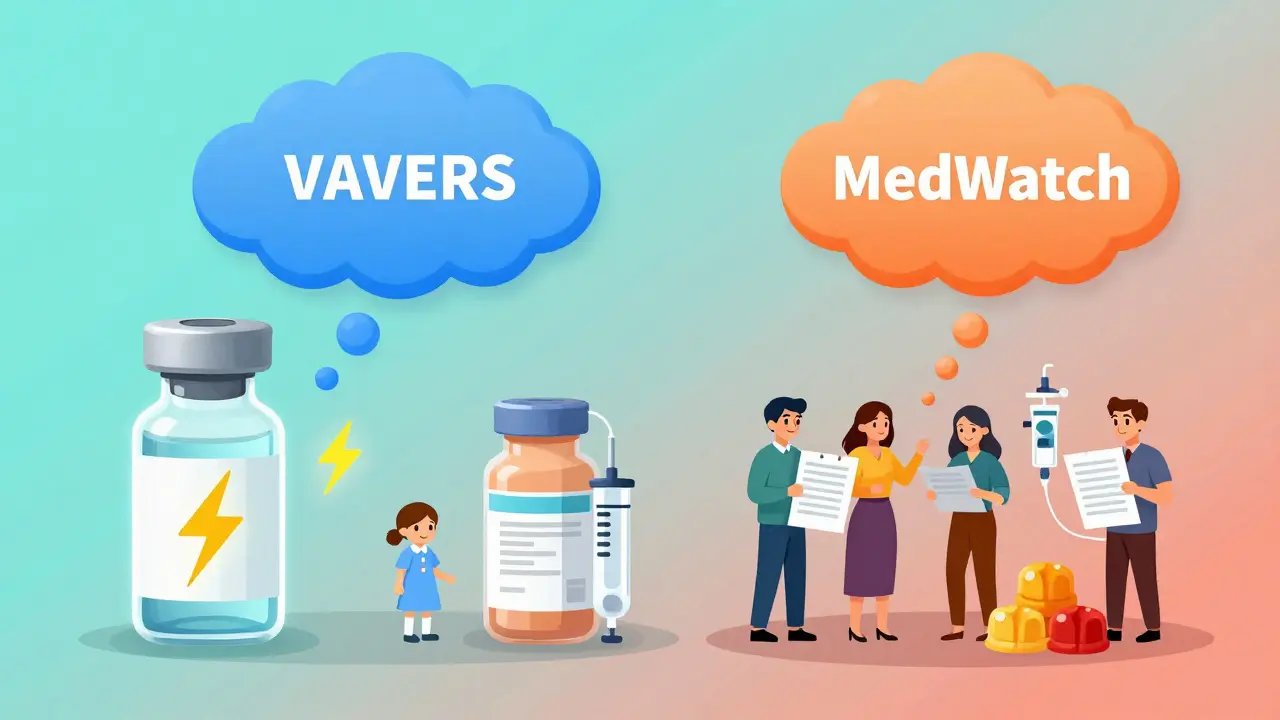
VAERS/MedWatch Reporting Selector
This tool helps you determine the correct reporting system for your side effect report. Using the wrong system can delay or prevent the FDA from receiving your important information.
According to the article, less than 1% of actual vaccine side effects are reported to VAERS. Your report could help identify safety issues early.
When something bad happens after taking a pill or getting a shot, you might wonder: where do you report it? The answer isn’t simple. In the U.S., two separate systems handle side effect reports - one for vaccines, another for everything else. Confusing them can delay critical safety checks or even cause reports to get lost. Understanding the difference between MedWatch and VAERS isn’t just bureaucratic detail - it’s how the system stays safe for everyone.
What Is VAERS?
VAERS stands for Vaccine Adverse Event Reporting System. It’s the official U.S. system for collecting reports of health problems that happen after someone gets a vaccine. It doesn’t decide if the vaccine caused the problem - it just collects the data. Anyone can file a report: doctors, nurses, parents, patients, even strangers who noticed something odd after a shot.
VAERS was built for speed, not proof. If a child gets a high fever the day after their MMR shot, or an adult ends up in the hospital after a flu vaccine, that goes into VAERS. So does a rare allergic reaction, a seizure, or even a death - if it happens close in time to vaccination. The system doesn’t care if you’re sure it was the vaccine. If you’re unsure, report it anyway. That’s how early warnings get spotted.
VAERS uses a detailed form that asks for the vaccine brand, lot number, date given, symptoms, medical history, and other meds taken. Serious events - like hospitalization, permanent disability, or death - trigger follow-ups. CDC and FDA staff may call the doctor for medical records. But here’s the catch: VAERS gets less than 1% of actual vaccine side effects reported. Many people don’t know about it. Others assume it’s not their job to report. That’s why VAERS can’t be used alone to say whether a vaccine is dangerous.
What Is MedWatch?
MedWatch is the FDA’s system for tracking side effects from everything that’s not a vaccine. That includes prescription drugs, over-the-counter medicines, medical devices like pacemakers or insulin pumps, dietary supplements, and even tobacco products. If you had a bad reaction to your blood pressure pill, your new knee implant started hurting, or your CBD gummies made you dizzy - MedWatch is where it goes.
Unlike VAERS, MedWatch has legal teeth. Drug and device makers must report serious side effects to the FDA within 15 days. Hospitals and clinics that use medical devices are also required to report certain events. But the public can still report too. You don’t need to be a doctor. If your headache got worse after starting a new antidepressant, you can file a report directly.
MedWatch forms ask for different details: drug name, dosage, how long you took it, symptoms, and other health conditions. The FDA routes these reports to the right center - like the Center for Drug Evaluation and Research for pills, or the Center for Devices for implants. These teams look for patterns. If 50 people report the same rare heart rhythm issue after taking a new statin, the FDA might investigate further. That’s how recalls or safety warnings happen.
Key Differences Between VAERS and MedWatch
The biggest mistake people make is mixing them up. You never send a vaccine report to MedWatch. And you never send a drug reaction to VAERS. They’re two separate pipes, feeding two separate systems.
- Scope: VAERS = vaccines only. MedWatch = everything else.
- Who runs it: VAERS is run by the CDC and FDA together. MedWatch is run solely by the FDA.
- Reporting rules: For VAERS, healthcare providers must report certain serious events after vaccination. For MedWatch, manufacturers are legally required to report serious events for drugs and devices.
- Data focus: VAERS collects vaccine lot numbers and exact timing between shot and symptom. MedWatch focuses on drug dosage, duration of use, and medical history.
- Underreporting: Both suffer from low reporting rates, but VAERS is especially underused by the public. Fewer than 1 in 100 vaccine reactions get reported.
Think of it like this: VAERS is a smoke alarm for vaccines. It doesn’t know if there’s a fire - it just screams when something unusual happens. MedWatch is a network of inspectors checking every appliance in the house for electrical faults. One watches for sparks after a spark plug (vaccine). The other watches for frayed wires in the whole house (drugs and devices).
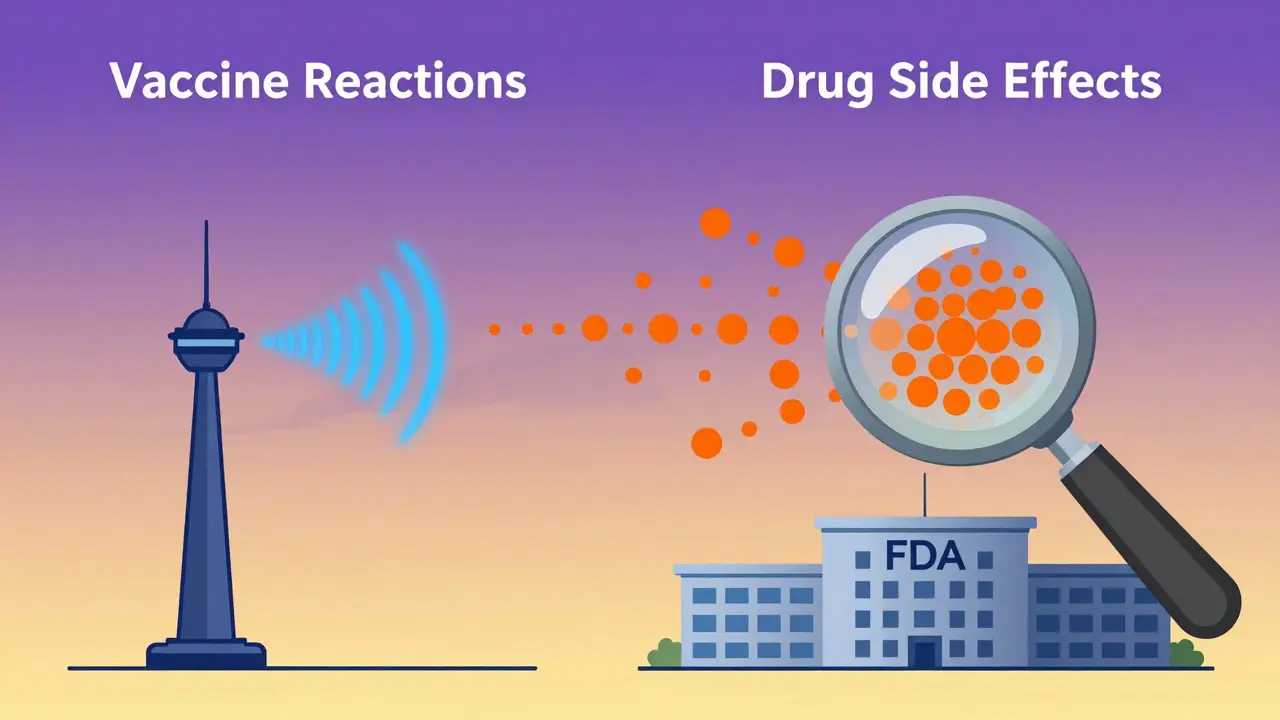
Why You Should Report - Even If You’re Not Sure
Some people think, “I don’t know if it was the shot or the drug - why bother?” But that’s exactly why you should report.
Let’s say 100 people take a new diabetes drug. Ten of them report sudden blurred vision. That’s a tiny number - maybe one person’s vision problem was from staring at a screen too long. But if 100 people report it? That’s a pattern. The FDA sees it. They dig deeper. They find the drug affects a specific enzyme in the eye. A warning gets issued. People change prescriptions. Blindness is avoided.
Same with vaccines. In 2010, VAERS started getting reports of a rare neurological condition called Guillain-Barré syndrome after a new flu vaccine. It was rare - just a few dozen cases. But because the system caught it early, scientists ran tests. They found a small increased risk in people over 65. The CDC adjusted recommendations. Older adults got a different version. Lives were saved.
Your report doesn’t have to be perfect. It doesn’t have to prove causation. It just has to be honest. A date. A symptom. A product name. That’s enough to start the process.
How to Report to VAERS or MedWatch
Reporting is free, fast, and doesn’t require a doctor’s note.
To report a vaccine side effect to VAERS:
- Go to vaers.hhs.gov
- Click "Report a Vaccine Reaction"
- Fill out the form online. You can do it yourself or have your doctor help.
- Include the vaccine name, lot number (from the sticker on the vial), date given, and symptoms.
- Submit. You’ll get a confirmation number.
To report a drug, device, or supplement side effect to MedWatch:
- Go to fda.gov/medwatch
- Download Form 3500 (PDF) or report online.
- Fill in the product name, dosage, how long you used it, symptoms, and your medical history.
- Submit. You can do it anonymously.
You can also call VAERS at 1-800-822-7967 or MedWatch at 1-800-FDA-1088. If you’re in a hospital and something goes wrong, ask your nurse to file it. They’re trained to do it.

What Happens After You Report?
Nothing dramatic. You won’t get a call back. You won’t get a diagnosis. That’s not how these systems work.
Reports go into a giant database. Computers scan for clusters - like 100 reports of dizziness after a new migraine drug in the same month. If a pattern emerges, FDA scientists dig deeper. They cross-check with medical records, insurance claims, and other systems like the Vaccine Safety Datalink (VSD) or the FDA’s BEST program.
If the signal is strong enough, the FDA might:
- Update the drug’s warning label
- Require a new safety study
- Send a public alert to doctors
- Restrict who can use the product
- In rare cases, pull it off the market
None of this happens because of one report. But every report adds to the picture. Your report might be the 37th one that finally makes the system take notice.
Common Misconceptions
There’s a lot of noise online about these systems. Here’s what’s true and what’s not.
- Myth: VAERS proves vaccines cause serious side effects. Truth: VAERS collects reports - it doesn’t prove causation. Most reports are coincidental.
- Myth: If you report to MedWatch, your doctor will be in trouble. Truth: Reporting is confidential. Doctors aren’t penalized for side effects that are known risks.
- Myth: Only doctors can report. Truth: Anyone can. Patients, parents, caregivers - you’re part of the safety net.
- Myth: These systems are full of fake reports. Truth: While some reports are inaccurate, the system filters noise by looking for patterns across thousands of reports.
VAERS and MedWatch aren’t perfect. They’re not designed to be. They’re early warning systems - like radar. They don’t tell you what’s coming - they just show you something’s out there. It’s up to scientists to figure out what it is.
What to Do If You’re Not Sure Where to Report
If you got a vaccine and then had a reaction, report to VAERS. If you took a pill and got sick, report to MedWatch. If you’re confused, ask your pharmacist. They know the difference.
Still unsure? Here’s a quick rule:
- Shot? → VAERS
- Pill, patch, inhaler, implant, cream? → MedWatch
Don’t wait. Don’t assume someone else reported it. Your report matters.
Thousands of people take new medicines every day. Most are safe. But safety isn’t guaranteed - it’s built over time, one report at a time. The system doesn’t work without you.
Can I report a side effect if I’m not a doctor?
Yes. Anyone - patients, parents, caregivers, or even bystanders - can report side effects to either VAERS or MedWatch. You don’t need medical training. Just provide what you know: what product was used, when, and what happened.
Will reporting a side effect get me in trouble?
No. Reporting is confidential and voluntary. Your name isn’t shared publicly. Doctors and manufacturers aren’t punished for side effects that occur - they’re expected to report them too. The goal is safety, not blame.
Can VAERS prove a vaccine caused my child’s seizure?
No. VAERS collects reports of events that happen after vaccination, but it cannot determine cause. Many seizures occur after vaccines by coincidence - not because of them. Scientists use other systems like the Vaccine Safety Datalink to study whether there’s a true link.
How long does it take for a report to lead to a warning or recall?
There’s no set timeline. Some signals are caught within weeks; others take years. It depends on how many reports come in, how serious the event is, and whether other data supports the pattern. One report rarely causes action - it’s the pattern that matters.
What if I report to the wrong system?
If you accidentally send a vaccine report to MedWatch or a drug reaction to VAERS, the system will usually forward it to the right place. But it delays processing. To help speed things up, always report vaccines to VAERS and everything else to MedWatch.



Meenakshi Jaiswal on 19 December 2025, AT 04:31 AM
I just reported my nephew's fever after his MMR shot using VAERS-took me 8 minutes on my phone. No doctor needed. If you're unsure, just hit submit. It's free, anonymous, and honestly? It's the least we can do.
My sister thought it was 'overkill,' but now she gets it. We're not accusing anyone-we're just helping the system see what it might miss.
And yeah, I know it feels tiny. But if 100 people do it, that's 100 data points. And that's how warnings start.
Don't wait for someone else to do it. You're the one who saw it. You're the one who knows.
Also, if you're in India and wondering if this applies to you? Yes. Global data matters. VAERS isn't just for Americans.