
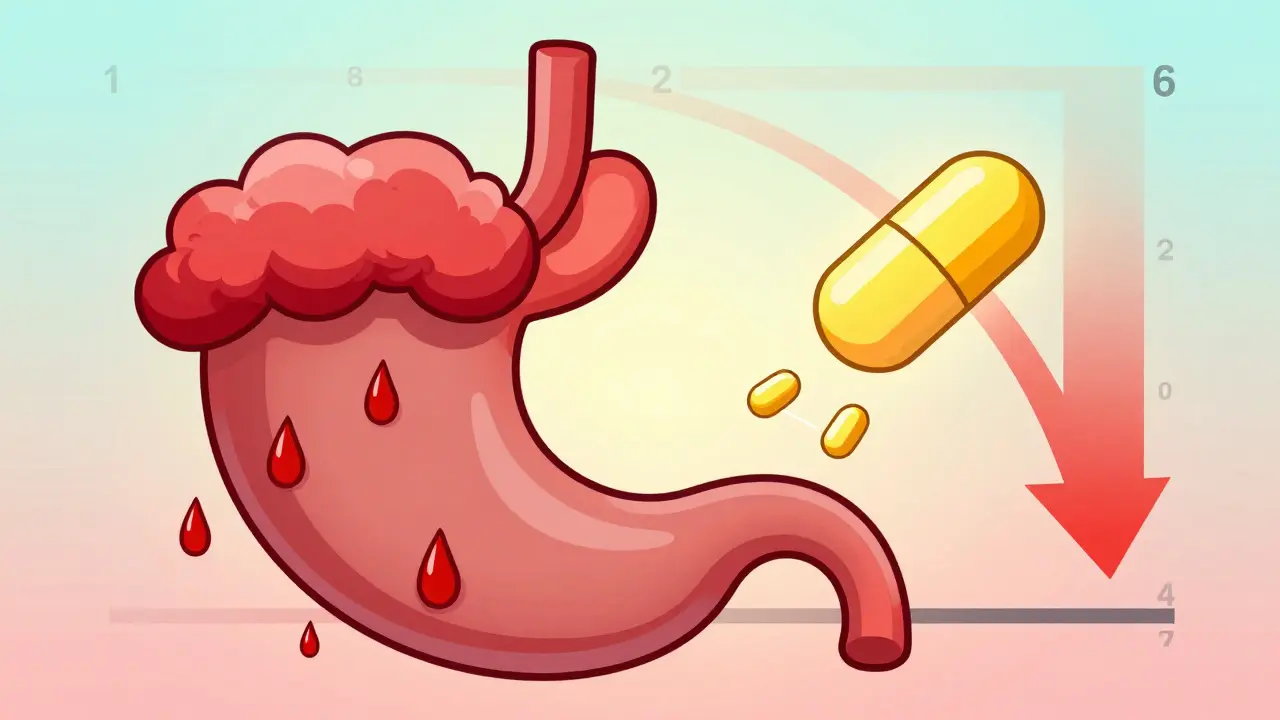
When you take a proton pump inhibitor (PPI) like omeprazole or pantoprazole for heartburn, you’re not just lowering stomach acid-you might be accidentally sabotaging your antifungal treatment. This isn’t theoretical. It’s happening in hospitals, clinics, and pharmacies every single day. And for patients fighting serious fungal infections, it can mean the difference between recovery and failure.
Why Your Stomach Acid Matters for Antifungal Drugs
Most people think of stomach acid as something to get rid of. But for certain antifungal medications, that acid is the key to getting the drug into your bloodstream. Drugs like itraconazole, posaconazole, and voriconazole are weak bases. That means they need an acidic environment to dissolve properly before they can be absorbed. When you take a PPI, your stomach pH rises from about 1-2 to 4-6. For itraconazole, that’s a disaster. Its solubility drops by 10 times for every single unit increase in pH above 3. A 2023 study in JAMA Network Open showed PPIs cut itraconazole’s total exposure (AUC) by 60%. That’s not a small drop-it’s enough to make the drug useless.The Big Three: Which Antifungals Are Most Affected
Not all antifungals react the same way. Here’s what actually happens in real patients:- Itraconazole capsules: These are the worst offenders. PPIs can slash absorption by 50-60%. A patient with aspergillosis might have trough levels drop from 1.5 mcg/mL to 0.3 mcg/mL-below the therapeutic threshold of 0.5-1.0 mcg/mL. This isn’t speculation. Hospital pharmacists report confirmed treatment failures.
- Itraconazole solution: This liquid form bypasses the problem. Because the drug is already dissolved, PPIs only reduce absorption by 10-15%. Switching from capsules to solution is one of the most effective fixes.
- Posaconazole delayed-release tablets: These also need acid. PPIs cut exposure by 40%. But if you take them with a cola or orange juice, you can recover 35% of that loss.
- Voriconazole: Moderate impact. PPIs reduce AUC by 22-35%. Some clinicians manage this by dosing voriconazole 2 hours before the PPI.
- Fluconazole: No problem. It’s highly water-soluble and absorbs fine regardless of pH. You can take it with any acid reducer without worry.
Why PPIs Are Worse Than H2 Blockers or Antacids
Not all acid reducers are created equal. PPIs shut down acid production for 12-24 hours. H2 blockers like famotidine only last 4-10 hours. Studies show omeprazole reduces itraconazole AUC by 57%, while famotidine cuts it by only 41%. Antacids? They cause a quick, short spike in pH. If you take them 2 hours apart from your antifungal, the effect is minimal. That’s why switching from a PPI to famotidine is often the best clinical move-especially for high-risk patients.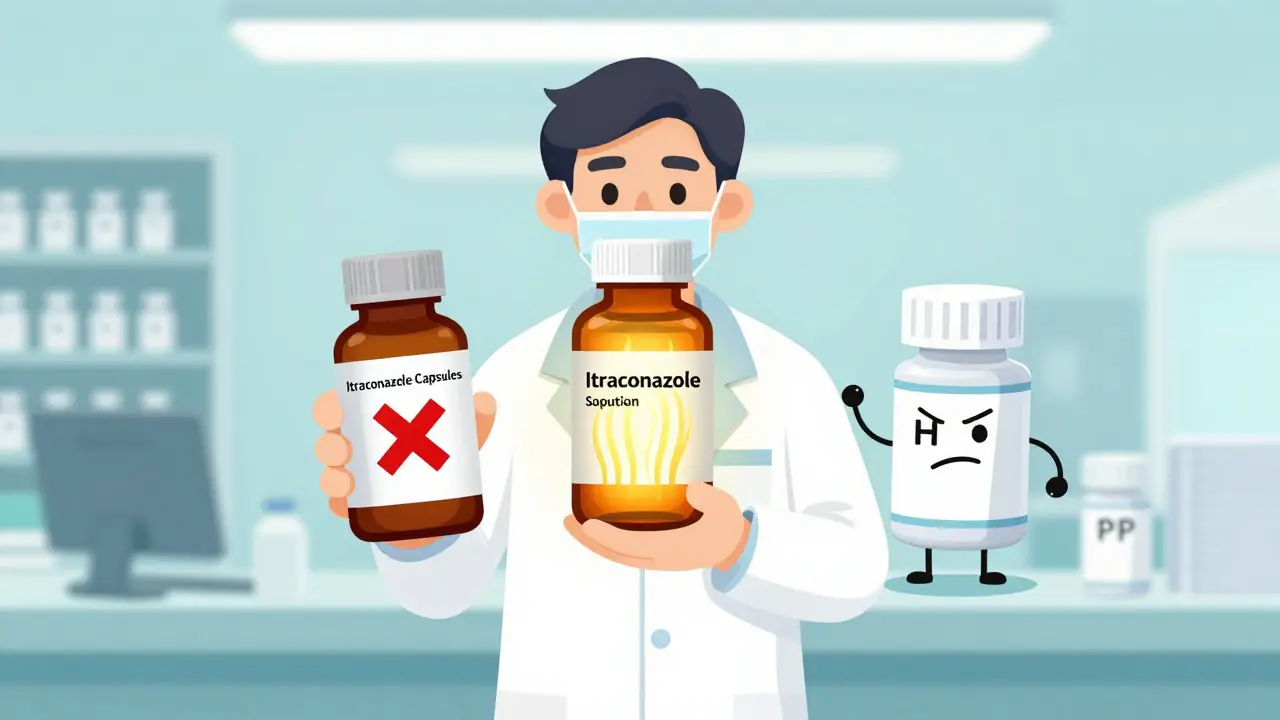
Real-World Consequences: What Happens When This Interaction Is Ignored
In 2022, a survey of 1,247 hospital pharmacists found 68% saw at least one itraconazole-PPI interaction every month. One pharmacist from Massachusetts General Hospital shared a case: a patient with chronic pulmonary aspergillosis had itraconazole levels stuck at 0.3 mcg/mL. After switching from omeprazole to famotidine, levels jumped to 1.7 mcg/mL. The infection cleared. But there’s a darker side. The same survey reported 23% had confirmed treatment failures. Patients with invasive aspergillosis or coccidioidomycosis died or needed emergency surgery because their antifungal didn’t work. The European Committee on Antimicrobial Susceptibility Testing (EUCAST) warns: subtherapeutic levels can make resistant fungi look like they’re responding-until they don’t. What looks like a treatment success is actually a breeding ground for drug-resistant strains.What Works: Practical Fixes for Clinicians and Patients
You don’t have to stop acid suppression. You just need to adjust.- Switch formulations: If someone is on itraconazole capsules, change them to the solution. It’s that simple.
- Change the acid reducer: Swap PPIs for famotidine. Give the antifungal 10 hours before the H2 blocker.
- Time it right: For posaconazole tablets, give them with an acidic drink. For voriconazole, give it 2 hours before the PPI.
- Monitor levels: If you’re using itraconazole or posaconazole, check trough levels. Target: 0.5-1.0 mcg/mL for itraconazole. If it’s below that, something’s wrong.
- Use the new formulation: Tolsura (new itraconazole) was approved in 2023. It’s pH-independent. PPIs only reduce its absorption by 8%. This is the future.
The Surprising Twist: PPIs Might Help-In the Lab
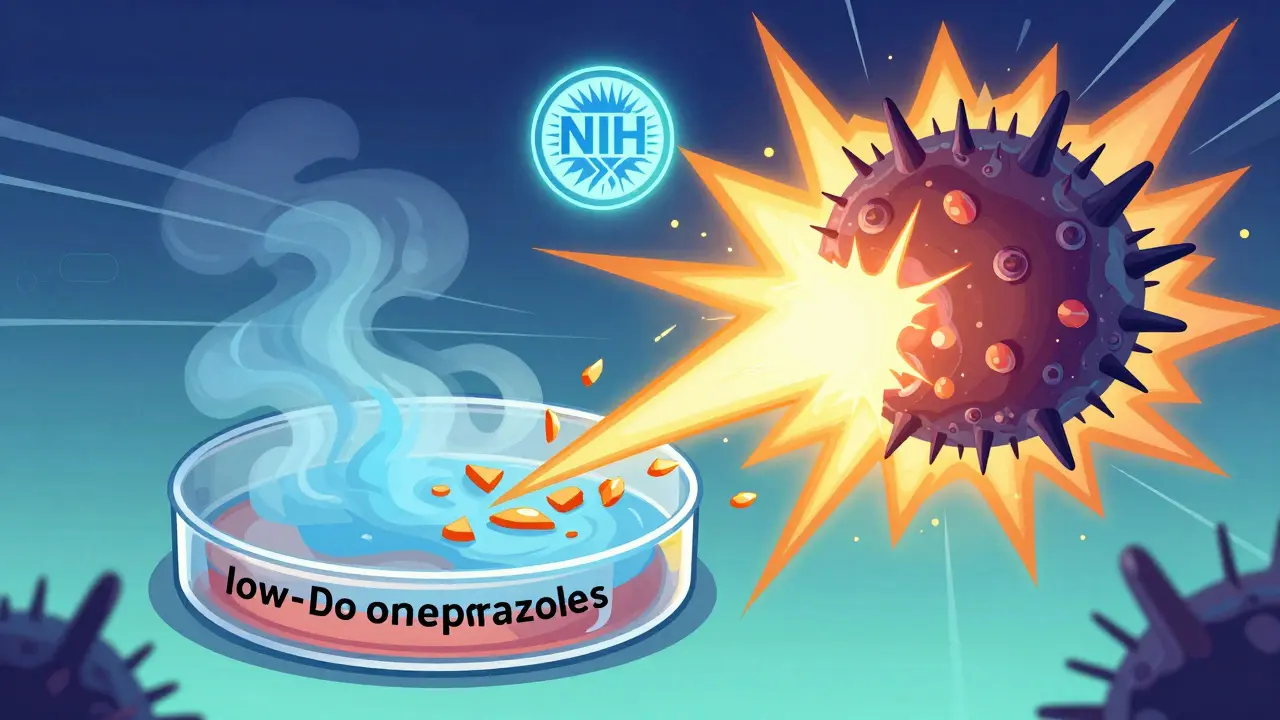
Here’s the twist no one expected. In a 2025 study in Frontiers in Pharmacology, researchers found that when you combine low-dose omeprazole with itraconazole in a petri dish, they work better together-especially against azole-resistant Aspergillus fumigatus. In 77.6% of tested strains, the combo killed the fungus more effectively than either drug alone. This isn’t just lab magic. The NIH launched a phase I trial in January 2024 (NCT05678901) to test whether low-dose omeprazole can boost weak antifungal doses in resistant infections. If it works, we might be looking at a whole new way to treat drug-resistant fungi. But don’t try this at home. The lab dose isn’t the same as your heartburn pill.Who’s at Risk? The Hidden Overlap
About 15% of U.S. adults take PPIs long-term. In hospitals, 5-7% of patients get systemic antifungals. That means thousands are on both. Medicare data shows 38.7% of patients prescribed itraconazole capsules also got a PPI in the same month. Only 12.3% of those on itraconazole solution did. That gap? It’s proof that awareness is growing-but still not enough.The Bottom Line
This isn’t about avoiding PPIs. It’s about matching the right antifungal with the right acid control. Fluconazole? No problem. Itraconazole capsules? High risk. Switch to solution or Tolsura. Use famotidine instead of omeprazole. Monitor levels. Time doses. And if you’re treating a resistant fungal infection, don’t ignore the possibility that your acid reducer is the reason the antifungal isn’t working.The science is clear. The solutions exist. What’s missing is consistent practice. If you’re managing antifungal therapy, ask: Is this patient on a PPI? And if so, what are you doing about it?
Can I take fluconazole with a proton pump inhibitor?
Yes. Fluconazole is highly water-soluble and doesn’t rely on stomach acid for absorption. Multiple studies confirm its levels stay steady whether you’re on omeprazole, famotidine, or nothing at all. You don’t need to adjust timing or switch medications.
Why does itraconazole capsule fail with PPIs but the solution doesn’t?
Itraconazole capsules contain solid drug particles that need to dissolve in stomach acid. When pH rises above 3, they don’t dissolve well-so they pass through the gut unused. The solution is already dissolved in liquid, so it doesn’t need acid. It’s absorbed directly in the intestines. That’s why switching to solution fixes the problem.
Is it safe to stop my PPI just to take an antifungal?
Not always. If you’re on a PPI because you have a history of GI bleeding, ulcers, or severe GERD, stopping it suddenly could be dangerous. The risk of bleeding or worsening symptoms may outweigh the benefit of slightly higher antifungal levels. The best approach is to switch to an alternative acid reducer like famotidine, not stop acid suppression entirely.
Can I just take my antifungal and PPI at different times of day?
For itraconazole capsules, no. Even if you take them 12 hours apart, PPIs suppress acid for a full day. The effect lasts longer than the drug’s half-life. For itraconazole solution or voriconazole, spacing them 2 hours apart can help-but it’s not foolproof. The safest strategies are switching formulations or acid reducers, not relying on timing alone.
What’s Tolsura, and why is it different?
Tolsura is a new formulation of itraconazole approved by the FDA in 2023. It uses a special delivery system that doesn’t require stomach acid to dissolve. Studies show PPIs reduce its absorption by only 8%, compared to 50-60% for regular capsules. This makes it the preferred option for patients who need ongoing acid suppression.
Should I get my antifungal levels checked?
If you’re taking itraconazole, posaconazole, or voriconazole and also on a PPI, yes. Therapeutic drug monitoring is standard for these drugs in serious infections. Target levels are 0.5-1.0 mcg/mL for itraconazole. If your level is below that, your PPI might be the cause. This isn’t routine for everyone-but it should be for high-risk patients.



Timothy Olcott on 20 March 2026, AT 14:31 PM
Bro this is wild 😱 I had no idea my omeprazole was sabotaging my antifungal. I’ve been on both for years. My doc never said a word. Now I’m scared to even sneeze. Switched to famotidine today. If I die, tell my dog I loved him. 🐶💔