

One minute you’re walking up the stairs, the next you can’t catch your breath. No chest pain. No fever. Just this overwhelming, unexplainable gasping for air. If this has happened to you-or someone you know-it’s not just being out of shape. It could be a pulmonary embolism, a blood clot blocking blood flow in your lungs. And it’s more common than most people think.
Every year in the U.S. alone, about 100,000 people die from pulmonary embolism (PE). Many of them were told they had anxiety, asthma, or a bad cold before the real cause was found. The problem? PE doesn’t always look like a heart attack or pneumonia. It sneaks in with subtle signs that are easy to ignore-especially if you’re young, active, or think you’re healthy.
Why Sudden Shortness of Breath Is the Biggest Red Flag
Eighty-five percent of people with pulmonary embolism experience sudden or worsening shortness of breath. Not gradual. Not after exercise. Not because they’re winded from climbing stairs. It hits fast-like someone turned off the air. In massive clots, it’s so severe that people can’t speak in full sentences. Even at rest.
But here’s what makes it tricky: if the clot is small, the breathlessness might feel mild, like you’re just tired. Some patients report it started weeks before diagnosis. One woman in Perth told her doctor she’d been struggling to breathe on the bus for three weeks. She thought it was stress. Turns out, it was a clot from a deep vein in her leg that traveled unnoticed.
Shortness of breath in PE doesn’t come with wheezing or coughing like asthma. It’s a quiet, suffocating feeling. You might feel fine sitting down, but as soon as you stand or move, your body screams for oxygen. And no matter how hard you try to breathe, it never feels enough.
Other Symptoms You Can’t Afford to Ignore
Shortness of breath is the main sign-but it’s rarely alone. Here’s what else often shows up:
- Chest pain-sharp, stabbing, worse when you breathe in or cough. It’s often mistaken for a heart attack. About 74% of PE patients have this.
- Cough-sometimes dry, sometimes with blood. Around 23% of people cough up even a little blood.
- Leg swelling-especially in one leg. That’s often where the clot started. About 44% of PE cases have a deep vein thrombosis (DVT) in the leg.
- Fast heartbeat-over 100 beats per minute, even when you’re not moving.
- Fainting-this is a late sign. If you pass out with no warning, it’s a medical emergency. Around 14% of PE patients experience syncope.
And here’s the kicker: none of these symptoms are unique to PE. That’s why it’s missed so often. A 2022 survey in Australia found 68% of PE patients visited a doctor at least twice before getting the right diagnosis. One person was told they had pneumonia. Another, asthma. One man was sent home with antacids because his chest pain “didn’t look cardiac.” He collapsed two days later.
How Doctors Diagnose It-Step by Step
Diagnosing PE isn’t about one test. It’s a chain of decisions, starting with risk and symptoms.
First, doctors use tools like the Wells Criteria or Geneva Score. These aren’t magic formulas-they’re checklists. Points for things like: recent surgery, leg swelling, heart rate over 100, no other explanation for shortness of breath. Add them up, and you get a score: low, moderate, or high risk.
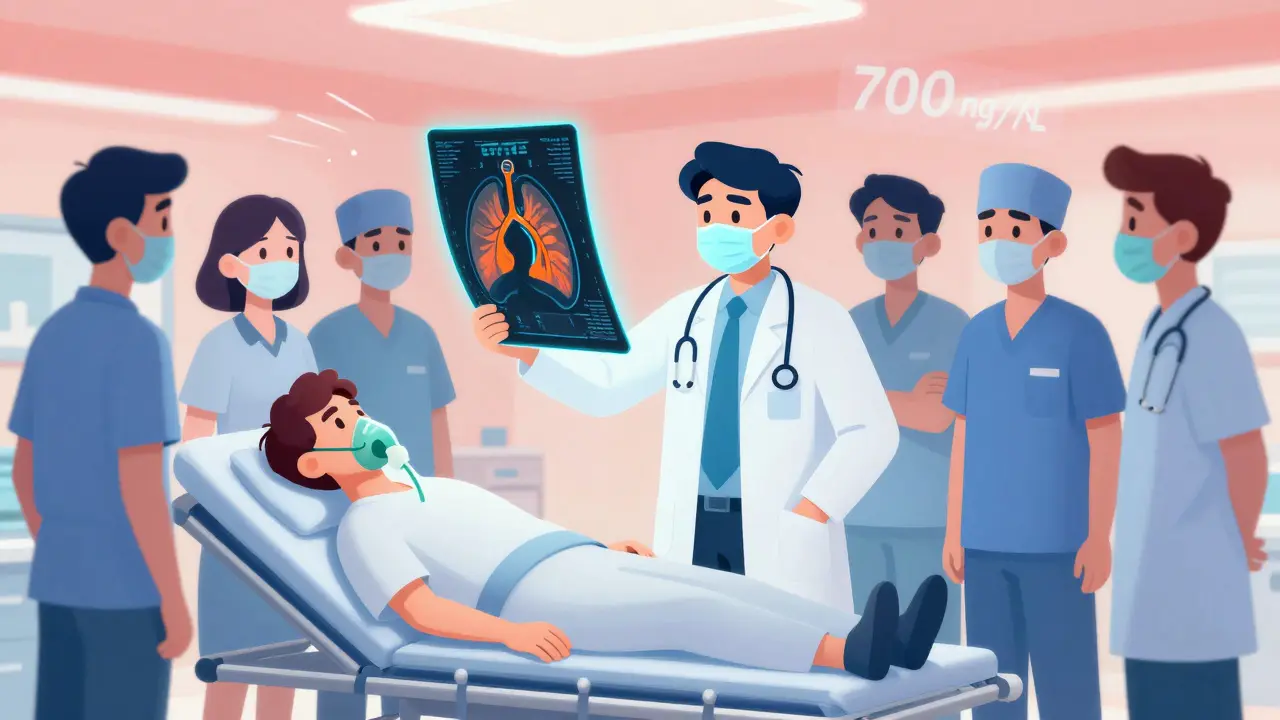
If you’re low risk, they’ll check a blood test called D-dimer. This measures a substance released when clots break down. A negative D-dimer (<500 ng/mL) means PE is extremely unlikely-97% accurate-if you’re young and healthy. But here’s the catch: if you’re over 50, the test gets less reliable. That’s why doctors now use age-adjusted D-dimer-the limit goes up by 10 ng/mL for every year over 50. So a 70-year-old’s normal is 700 ng/mL, not 500.
If the D-dimer is high-or you’re high risk no matter what-the next step is imaging.
The Gold Standard: CTPA Scan
The most accurate way to see a clot in your lungs is a CT pulmonary angiography (CTPA). It’s a CT scan with contrast dye injected into your arm. The dye lights up your pulmonary arteries, and the machine takes pictures to show if anything’s blocked.
CTPA catches 95% of PEs. It’s fast-takes under 10 minutes. But it’s not perfect. You need good kidney function to handle the dye. Radiation exposure is low (about 5-7 mSv), but it’s still radiation. And if you’re allergic to iodine, you can’t have it.
For those cases, doctors turn to ventilation/perfusion (V/Q) scanning. This test looks at airflow and blood flow in your lungs separately. It’s less common now, but still used when contrast is risky. It’s 85% accurate at spotting PE.
In emergencies-like if you’re crashing, low on blood pressure, or fainting-doctors skip the scans and go straight to echocardiography. An ultrasound of your heart can show if your right ventricle is strained from the clot. That’s a sign of massive PE. And it’s life-threatening.
What Happens If the Clot Is in Your Leg?
Most PEs start as deep vein thrombosis (DVT) in the leg. That’s why doctors check your legs. A simple ultrasound-non-invasive, no radiation-can find clots in the big veins. If it’s positive, that’s strong evidence you have a PE, even without a scan.
Ultrasound is 90%+ accurate for clots in the upper leg. If you have swelling, pain, or warmth in one calf, that’s a red flag. And if you’ve had a DVT before? Your risk of another PE jumps. One study found 33% of people with a past clot will get another within 10 years.
Why Some People Are at Much Higher Risk
Not everyone has the same chance of getting PE. Here are the big risk factors:
- Cancer-cancer patients have nearly 5 times higher risk. Some chemo drugs thicken the blood. Tumors also release substances that trigger clotting.
- Recent surgery-especially hip, knee, or abdominal. You’re still for hours, blood pools, clots form.
- Long flights or bed rest-sitting still for 6+ hours increases risk. That’s why pilots, truck drivers, and hospital patients get anticoagulants.
- Birth control or HRT-estrogen increases clotting risk. This is why doctors ask about pills or patches before prescribing them.
- Genetic clotting disorders-like Factor V Leiden. These are rare, but they make clots form too easily.
And yes-climate change is now linked to higher PE rates. Warmer temperatures cause dehydration and thicker blood. University of Washington researchers estimate this could cancel out 8% of the progress we’ve made in reducing PE deaths.

What’s New in Diagnosis? AI and Special Teams
Things are getting faster. Hospitals now use Pulmonary Embolism Response Teams (PERT)-groups of specialists who jump in when PE is suspected. They cut treatment delays from days to hours. One hospital in the U.S. slashed mortality from 8.2% to 3.1% just by using structured pathways.
And artificial intelligence? It’s helping read CT scans. Algorithms like PE-Flow can spot tiny clots humans might miss. In a 2022 trial, AI matched radiologists in accuracy-93.7% sensitivity, 96.2% specificity. It doesn’t replace doctors. It just helps them see faster.
There’s also new blood tests coming. Researchers are testing combinations of biomarkers-D-dimer plus thrombomodulin, plasmin-antiplasmin. Early results show a 98.7% negative predictive value. That means if these markers are normal, PE is almost certainly not there. This could cut down unnecessary scans by half.
What to Do If You Suspect PE
If you suddenly can’t breathe-and you have any risk factors-don’t wait. Don’t call your GP. Go to the emergency room. Say: “I think I might have a pulmonary embolism.” Be specific. Mention leg swelling. Mention recent surgery or travel. Mention if you’ve had a clot before.
Most hospitals now have protocols for PE. If you’re in a major city, you’ll likely get scanned within an hour. In rural areas? It might take longer. But if you’re crashing-fainting, blue lips, chest pain-don’t wait for an appointment. Call an ambulance.
Early diagnosis saves lives. Late diagnosis kills. And too many people are still being sent home with the wrong diagnosis.
What Happens After Diagnosis?
Once PE is confirmed, treatment starts immediately. Blood thinners-like heparin or warfarin-are given to stop the clot from growing. Newer drugs like rivaroxaban or apixaban are easier to take-no regular blood tests.
Most people go home after 2-5 days. But you’ll be on blood thinners for at least 3 months. Some need them for life-especially if the PE was unprovoked or you have cancer.
Recovery isn’t just about meds. You’ll need to move. Walking helps prevent new clots. Compression socks help with leg swelling. And you’ll need follow-up scans to check if the clot dissolved.
One big myth: PE isn’t a one-time event. It’s a warning. If you’ve had one, you’re at higher risk for the rest of your life. Stay alert. Stay informed. And never ignore sudden breathlessness again.
Can a pulmonary embolism go away on its own?
Small clots can dissolve over weeks or months without treatment, but that doesn’t mean it’s safe. While the body naturally breaks down clots, the risk of another clot forming-or the current one growing-is too high to wait. Untreated PE can lead to chronic lung damage, heart strain, or sudden death. Blood thinners are used not to dissolve the clot, but to prevent new ones from forming while your body clears the existing one.
Is pulmonary embolism the same as a heart attack?
No. A heart attack happens when a clot blocks blood flow to the heart muscle. A pulmonary embolism is a clot blocking blood flow to the lungs. They both cause chest pain and shortness of breath, but they affect different organs. The treatments are different too-heart attacks need immediate reopening of arteries, while PE is treated with blood thinners. Misdiagnosing one for the other can be deadly.
Can you get a pulmonary embolism without any known risk factors?
Yes. About 20-30% of PE cases are unprovoked-meaning no obvious cause like surgery, injury, or cancer. These are often linked to hidden genetic clotting disorders, undiagnosed cancer, or autoimmune conditions. That’s why doctors investigate further if you have a first-time PE with no clear trigger. It’s not random-it’s a signal.
How long does it take to recover from a pulmonary embolism?
Recovery varies. Most people feel better in a few weeks, but full recovery can take months. Breathing may still feel labored, especially during exercise. Some develop chronic high blood pressure in the lungs (chronic thromboembolic pulmonary hypertension), which requires long-term treatment. The key is sticking to your meds, moving regularly, and attending follow-ups. Don’t rush back to full activity-your lungs need time to heal.
Can you prevent a pulmonary embolism?
Yes, you can reduce your risk. Stay active-don’t sit for hours. Walk during long flights. Wear compression socks if you’re at risk. Drink water. Avoid smoking. If you’ve had a clot before, take your blood thinners as prescribed. After surgery, ask about anticoagulants. If you’re on birth control and have a family history of clots, talk to your doctor about alternatives. Prevention isn’t just about medication-it’s about lifestyle.



Andrew Freeman on 16 January 2026, AT 11:16 AM
bro i thought i was just out of shape till i passed out on the subway last yeardoc said anxiety then i collapsed again 3 weeks later
turns out clot from my leg
no chest pain no nothing
just couldnt breathe and everyone thought i was faking