
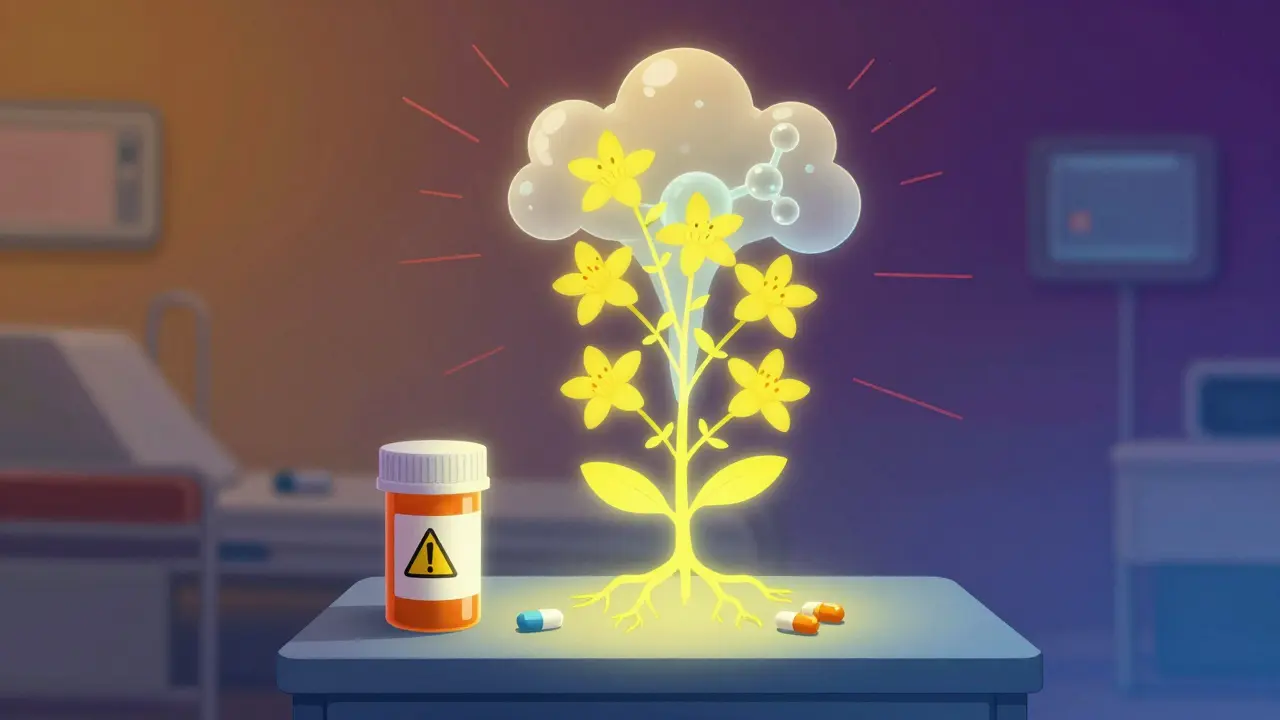
Combining St. John’s Wort with SSRIs isn’t just a bad idea-it can land you in the hospital. Even if you think of St. John’s Wort as a "natural" remedy for low mood, it’s not harmless. It’s a powerful biochemical actor that interacts with prescription antidepressants in ways most people don’t understand. And the risk? A life-threatening condition called serotonin syndrome.
What St. John’s Wort Actually Does in Your Body
St. John’s Wort (Hypericum perforatum) is a yellow-flowered plant used for centuries in Europe to treat mood disorders. Today, it’s sold as a supplement in the U.S. and parts of Europe, often marketed as a gentle alternative to antidepressants. Standard doses are 300 mg three times a day, with products labeled to contain 0.3% hypericin. But here’s the catch: it doesn’t work like a vitamin. It’s a drug in disguise.
The active compound, hyperforin, triggers your liver to crank up production of enzymes-specifically CYP3A4, CYP2C9, and CYP2C19. These are the same enzymes that break down many prescription medications. When they’re overactive, your body flushes out drugs too fast. That’s why St. John’s Wort can make birth control pills fail, weaken seizure meds like carbamazepine, or drop warfarin levels enough to cause dangerous clots.
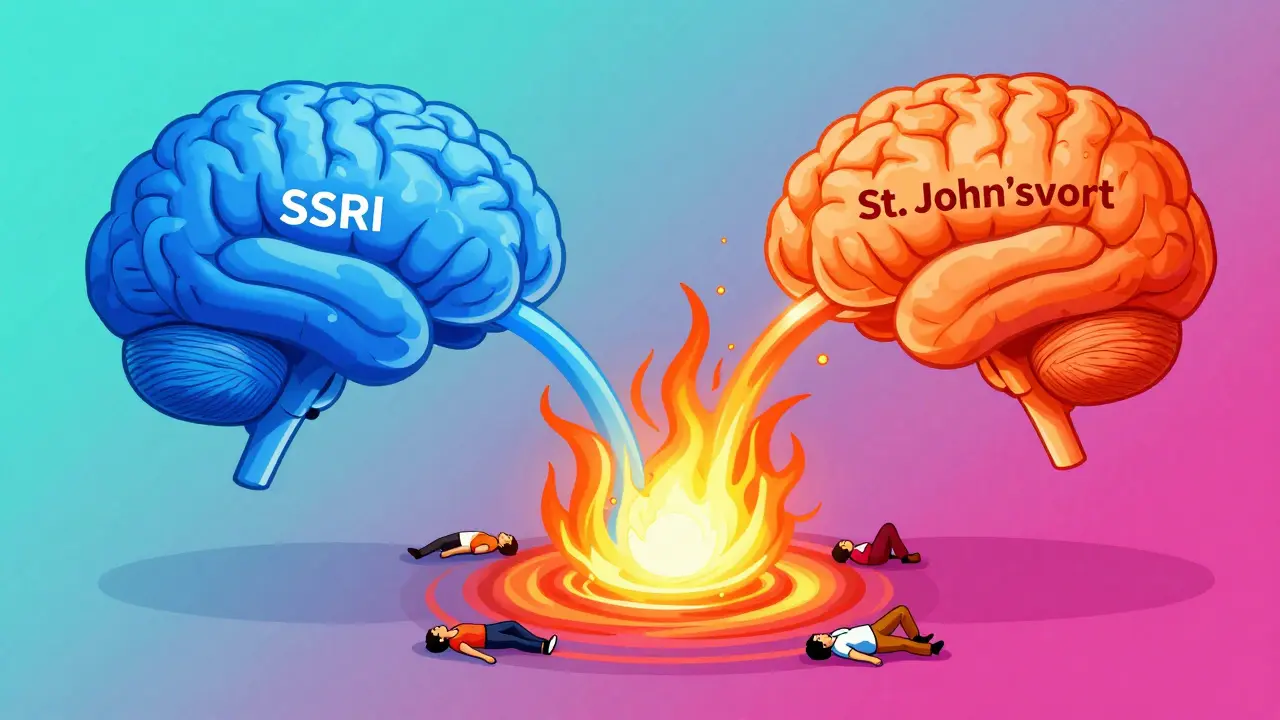
But the biggest danger isn’t just speeding up drug metabolism. St. John’s Wort also boosts serotonin directly. It blocks serotonin reuptake, just like SSRIs do. And it weakly inhibits monoamine oxidase, another pathway that increases serotonin. So when you add it to an SSRI, you’re stacking two serotonin-boosting effects on top of each other. That’s the recipe for serotonin syndrome.
What Is Serotonin Syndrome-and Why It’s Deadly
Serotonin syndrome isn’t a vague side effect. It’s a medical emergency. Your brain and nervous system get flooded with too much serotonin. Symptoms start mild: sweating, shivering, restlessness, nausea. But they can spiral fast. High fever (over 41°C or 106°F), muscle rigidity, seizures, irregular heartbeat, and kidney failure can follow. Death is possible.
There’s no single test for it. Doctors rely on the Hunter Serotonin Toxicity Criteria: you need at least three of these signs-mental changes, agitation, tremor, hyperreflexia, sweating, diarrhea, incoordination, or fever. Case reports show symptoms can appear within 24 hours or take up to two weeks. And here’s the scary part: many people don’t tell their doctors they’re taking St. John’s Wort. A 2021 study found only 32.7% of supplement users disclosed herbal use to their healthcare providers. They assume it’s safe because it’s "natural." It’s not.
Which SSRIs Are Most Dangerous to Mix With It?
Not all SSRIs carry the same risk, but all of them are risky. Some are worse than others.
SSRIs like sertraline and escitalopram are broken down by CYP2C19-the enzyme St. John’s Wort strongly induces. That means your body clears them faster, which might make you think the SSRI isn’t working. So you might increase the dose. Meanwhile, St. John’s Wort is still boosting serotonin. That double whammy is a known trigger for severe serotonin syndrome. In fact, 17 documented cases in a 2025 European review showed sertraline was involved in nearly half.
Paroxetine is metabolized by CYP2D6, which St. John’s Wort doesn’t affect as much. But it’s still been linked to serotonin syndrome. Why? Because it’s a potent serotonin reuptake blocker on its own. Add St. John’s Wort, and even without enzyme changes, you get too much serotonin in the synapses.
Fluoxetine is different. It sticks around in your system for weeks. If you stop St. John’s Wort and start fluoxetine, you’re still getting serotonin-boosting effects from the herb for days. That’s why experts recommend waiting at least two weeks after quitting St. John’s Wort before starting any SSRI-and vice versa.
Why Doctors Miss This Risk
Most doctors don’t ask about herbal supplements. They ask about alcohol, smoking, and prescription meds. They don’t ask about the little brown bottle on your nightstand labeled "natural mood support."
Patients don’t volunteer the info. They think it’s harmless. Or they don’t think it counts as "medicine." A 2023 survey found 12.3% of U.S. adults use St. John’s Wort. That’s over 30 million people. Many are self-treating mild depression, not realizing they’re already on an SSRI-or planning to start one.
And the supplement industry doesn’t help. Labels don’t warn about SSRIs. They say "supports emotional balance" and leave it at that. The FDA doesn’t require pre-market safety testing for supplements. So a product can be sold with no proof it works, and no clear warnings about deadly interactions.
Other Medications St. John’s Wort Ruins
It’s not just SSRIs. St. John’s Wort messes with a long list of drugs:
- Birth control pills: Increases metabolism by 30-50%. Documented cases of unplanned pregnancy.
- Warfarin: Lowers INR by 25-35%. Risk of stroke or blood clots.
- Cyclosporine and tacrolimus: Levels drop by 50-70%. Organ transplant rejection risk.
- Phenytoin, carbamazepine: Seizure control fails.
- HIV meds like indinavir: AUC drops 57%. Viral resistance can develop.
These aren’t theoretical. They’re real cases, documented in medical journals. The mechanism is always the same: hyperforin turns on the pregnane X receptor (PXR), which switches on liver enzymes that break down drugs too fast.

What to Do Instead
If you’re on an SSRI and thinking about trying St. John’s Wort: don’t. The risks are real, proven, and deadly.
If you’re already taking St. John’s Wort and your doctor wants to start you on an SSRI: stop the herb at least two weeks before. Give your body time to clear it. Tell your doctor you were using it. Don’t assume they know.
If you’re using St. John’s Wort for depression and it’s not working well enough: talk to your doctor about evidence-based options. Cognitive behavioral therapy (CBT) works as well as antidepressants for mild to moderate depression-with zero interaction risk. Exercise, sleep hygiene, and light therapy are also proven, safe tools.
There’s no need to risk your life for a supplement that’s not regulated, not fully understood, and not safer than the real thing.
What Regulators Are Doing
Canada banned over-the-counter sales of St. John’s Wort in 2023 after 17 serotonin syndrome cases. The FDA has issued 12 safety alerts since 2018. In 2024, they proposed requiring clear warning labels on all packaging: "Do not use with antidepressants. Risk of serotonin syndrome."
The European Medicines Agency already has a full contraindication. The American Psychiatric Association’s 2022 guidelines call concurrent use "contraindicated." The Mayo Clinic, Cleveland Clinic, and Medsafe all say the same: avoid it completely.
Yet sales in the U.S. hit $156 million in 2022. People are still buying it. They’re still mixing it. And they’re still ending up in emergency rooms.
Bottom Line: Don’t Take the Risk
St. John’s Wort isn’t a gentle herb. It’s a potent, unregulated drug with dangerous interactions. Mixing it with SSRIs isn’t a gamble-it’s a guaranteed threat to your nervous system. Serotonin syndrome doesn’t wait for permission. It doesn’t care if you "only took it for a few days." It doesn’t care if you think it’s "natural." If you’re on an SSRI, stop taking St. John’s Wort. If you’re thinking of starting one, stop the herb first. Tell your doctor what you’re taking-even if it’s not on a prescription bottle. Your life depends on it.



John Hay on 21 December 2025, AT 19:33 PM
This isn't even close to being a debate. St. John’s Wort isn't a supplement-it's a stealth drug. People think 'natural' means safe, but that's the dumbest myth going. I've seen three friends end up in the ER because they thought mixing it with their Zoloft was fine. One of them had a seizure. No joke. Stop pretending herbal means harmless.